


In this article, you will discover 3 Italian books that I absolutely recommend you read. These are three very different novels, but all three will help you improve your Italian and will let you discover important aspects of Italian culture and mentality. There’s also my favorite one, and you’ll understand why…
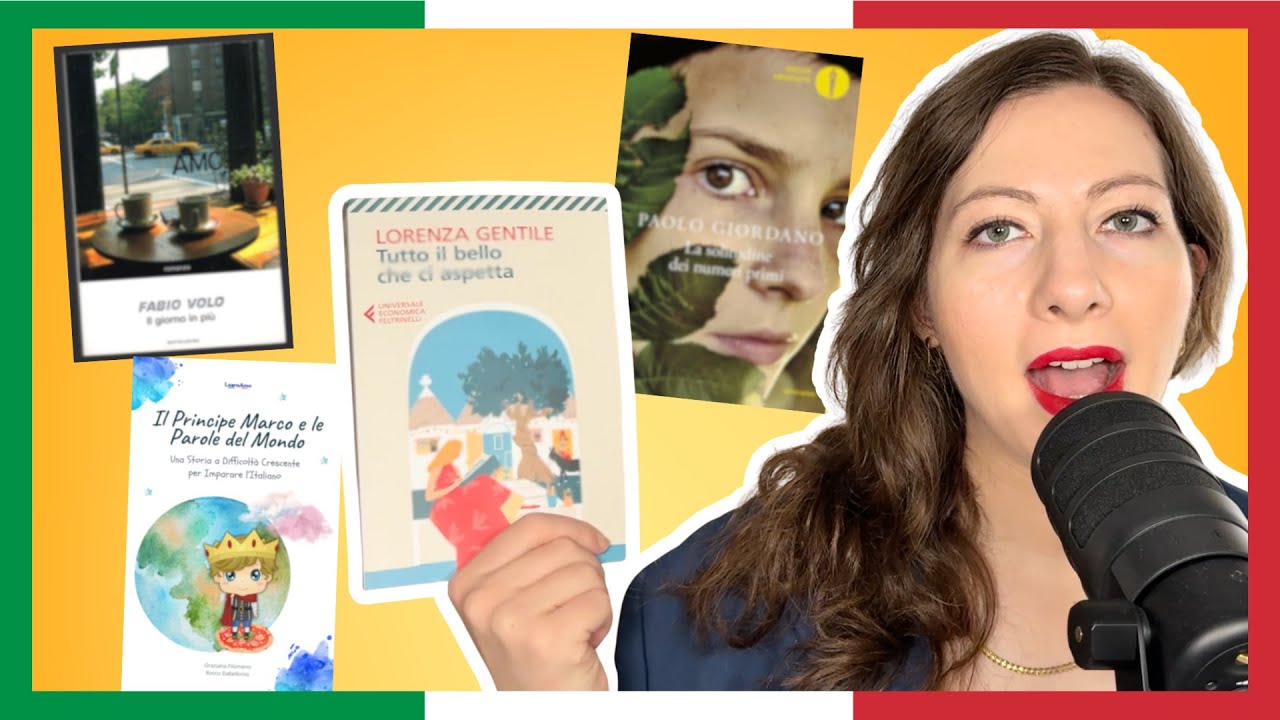
What to Read in Italian? I suggest 3 books!
FIRST BOOK: “Il giorno in più” by Fabio Volo
The first book I want to recommend is perfect if you’re looking for an easy, smooth, and pleasant read. It’s “Il giorno in più” [One More Day] by Fabio Volo, published in 2007.
Who is Fabio Volo?
Before talking about the book, let me introduce the author! Fabio Volo is one of the most popular Italian writers of the last twenty years. But he’s not just a writer: he’s also an actor, radio and television host, and a true personality in the Italian entertainment world. His books have sold millions of copies and are especially loved by young adults, but actually appeal to people of all ages!
What is “Il giorno in più” about?
Giacomo, a man in his thirties, lives a normal life, in some ways too normal. He lives and works in Italy, his existence is marked by the daily routine. The only reason for excitement for Giacomo is the daily sight of a woman on the tram that takes him to work. The two never speak to each other, but at the same time they are accomplices. They exchange furtive glances and barely hinted smiles.
After many days marked by these moments of mutual silent attention, Michela, this being the name of the mysterious woman, introduces herself to Giacomo, exchanges a few words with him, and tells him that she has decided to move to New York for work. For Giacomo it’s a hard blow, since he finds himself deprived of that one small pleasure of every day.
After a period of doubt, the protagonist manages to trace Michela’s office address and decides to leave for New York. There he meets the woman and begins a passionate love story, made of intense moments and deep attraction.
Why do I recommend this book?
First of all, Fabio Volo’s language is extremely colloquial and modern. Reading his books, you’ll have the impression of listening to a friend telling you a story at a bar. This means you’ll learn tons of expressions that Italians really use in everyday life!
For example, you’ll find phrases like:
- “Mi sono fatto un sacco di domande” [I asked myself a lot of questions]
- “Non ci sto capendo niente” [I’m not understanding anything about it]
- “Ho bisogno di staccare la spina” [I need to unplug/disconnect]
All perfect expressions to enrich your spoken Italian.
Secondly, the themes addressed are universal: all of us, sooner or later, ask ourselves questions about the meaning of life, love, work, happiness. Reading this book, you’ll not only improve your Italian, but you’ll probably recognize yourself in many of the protagonist’s reflections!
Cultural Curiosity
Fabio Volo is so popular in Italy that when he releases a new book, it immediately becomes a bestseller. His novels are perfect for those who want to understand the mentality of contemporary Italians, especially the younger generations. Moreover, some of his books have been turned into films – “Il giorno in più” is no exception: in 2011 it became a film directed by Fabio Volo himself!
My Advice
If you’re at a beginner-intermediate level (A2-B1), this is the perfect book for you. It’s easy to read, smooth, and the story will keep you company without ever boring you.
Book Characteristics
| Characteristic | Description |
| Plot | Simple and linear |
| Main Themes | Fear of change, life choices, courage to risk for one’s dreams |
| Message | Invitation to weigh anchor and set off on a journey without a life vest |
| Recommended Level | A2-B1 (Beginner-Intermediate) |
| Style | Colloquial, modern, smooth |
Quote from the book:
“Il senso di libertà che ho avvertito quel mattino non lo avevo mai provato. Qualsiasi cosa mi sembrava diversa. Mi pareva di poter fare tutto ciò che volevo. Avevo la vita in mano, la mia giornata, il mio destino. Tutto era lì. Avere una giornata davanti a me senza impegni, orari, scadenze mi faceva sentire Dio. Mi sono seduto su una panchina. Non c’era una vista particolare. Solo desideravo guardare cosa accadeva in quella strada. Ho pensato molto a quel che stavo vivendo, a Michela, al tempo passato con lei.” [The sense of freedom I felt that morning I had never experienced before. Everything seemed different to me. It seemed I could do everything I wanted. I had life in my hands, my day, my destiny. Everything was there. Having a day ahead of me without commitments, schedules, deadlines made me feel like God. I sat down on a bench. There wasn’t a particular view. I just wanted to watch what was happening on that street. I thought a lot about what I was living, about Michela, about the time spent with her.]
SECOND BOOK (MY FAVORITE!): “Tutto il bello che ci aspetta” by Lorenza Gentile
And now we come to my favorite book among these three! It’s “Tutto il bello che ci aspetta” [All the Beauty That Awaits Us] by Lorenza Gentile, published in 2024. And when you finish reading the description, you’ll understand exactly why this book has a special place in my heart!
Who is Lorenza Gentile?
Lorenza Gentile was born in Milan in 1988 and is one of the freshest and most interesting voices in contemporary Italian fiction. She has written several successful novels, all characterized by a light but deep, ironic but touching style. Her protagonists are always strong, imperfect, real women, with whom it’s very easy to identify.
What is it about?
The protagonist is Selene, a thirty-four-year-old woman who lives in Milan and feels completely lost. Her restaurant is failing, her love life is a disaster, and she can’t find her way. Everyone around her seems to have the perfect life, while she feels increasingly inadequate and confused.
One day, she decides to do something brave: return to her hometown, a small white village in the heart of Puglia, where she grew up as a child in a spiritual community, an ashram. She wants to find herself again, understand what went wrong, reconnect with her roots.
But of course, nothing goes according to plan: her car breaks down just before arriving! While waiting for spare parts, she is given Amanda, an old red Fiat Uno full of personality (and trust me, Amanda will become a character in its own right!). Between trips to Salento, yoga at dawn, afternoons in the kitchen with old friends, rediscovering the flavors of Apulian cuisine and taking care of a little donkey named Virgilio, Selene will begin to rediscover herself and understand what she really wants from life.
Why is it my favorite book?
First of all, I must make a confession: I’m Apulian! I was born and raised in Puglia, and when I read this book I completely found myself in the descriptions of the landscapes, scents, colors, people. Lorenza Gentile managed to capture the essence of my land in a way that truly moved me. Reading the pages set in Salento, among the centuries-old olive trees, trulli, crystal-clear sea and white villages, I felt at home. And this is a beautiful gift that a book can give!
But that’s not the only reason I love it. Lorenza Gentile’s language is modern, fresh and authentic. You’ll find colloquial expressions, idioms typically Italian and dialogues that sound exactly like a conversation between friends.
For example, you might encounter phrases like:
- “Ma che ti passa per la testa?” [But what’s going through your head?]
- “Non se ne parla nemmeno!” [There’s no way!/Out of the question!]
Which are perfect for understanding how Italians really speak today.
Moreover, the book addresses universal themes – love, friendship, dreams, fears, the search for oneself, the desire to start over – but it does so with a light and ironic style. Lorenza Gentile is very good at using irony to talk about serious things, and this makes the reading not only educational, but also entertaining and engaging!
Cultural Curiosity
Reading this book, you’ll not only improve your Italian, but you’ll also take a virtual journey to one of the most beautiful regions in Italy: Puglia! You’ll discover the breathtaking landscapes of Salento, the traditional Apulian cuisine (prepare to get hungry!), local traditions and even a bit of Eastern spirituality mixed with Italian culture. It’s a fascinating mix!
My Advice
This book is perfect for those who have an intermediate level (B2). It’s simple enough to be enjoyable, but rich enough to make you learn a lot. And above all, it will make you fall in love with Puglia – just like me!
Book Characteristics
| Characteristic | Description |
| Setting | Puglia, Salento – white villages, centuries-old olive trees, crystal-clear sea |
| Main Themes | Search for oneself, starting over, roots, love, friendship, dreams |
| Protagonist | Selene – 34-year-old woman searching for her path |
| Special Elements | Yoga, Apulian cuisine, spiritual community, inner journey |
| Recommended Level | B2 (Intermediate) |
| Style | Light but deep, ironic, fresh, authentic |
| Bonus | Discovery of Apulian culture and traditions |
THIRD BOOK: “La solitudine dei numeri primi” by Paolo Giordano
Let’s now move on to a completely different novel, more challenging but incredibly beautiful: “La solitudine dei numeri primi” [The Solitude of Prime Numbers] by Paolo Giordano, published in 2008.
Who is Paolo Giordano?
Paolo Giordano was born in Turin in 1982 and is both a writer and a physicist. Yes, you read that right: he has a degree in theoretical physics! This scientific background is very much reflected in his writing style, which is precise, mathematical, almost surgical. “La solitudine dei numeri primi” is his first novel, written when he was only 26 years old, and it had extraordinary success both in Italy and abroad.
What is it about?
“La solitudine dei numeri primi” tells the parallel and intertwined lives of Alice and Mattia, two characters marked by childhood traumas that lead them to live on the margins.
Alice is the victim of a serious skiing accident that leaves her lame and causes her eating problems like anorexia. Mattia is tormented by guilt for having abandoned his autistic twin sister, Michela, who then got lost forever.
These two traumas will forever mark Alice and Mattia’s lives. The two meet as teenagers in high school and, despite their difficulties, a deep and unique bond is born between them. But will they be able to open up completely to each other and overcome their fears? The answer is in the very title of the book.
What are twin prime numbers?
The title refers to a very fascinating mathematical concept. Twin prime numbers are prime numbers that are close, separated by only one number (like 11 and 13, or 17 and 19). They are close, very close, but they never touch. There’s always that number in between that divides them.
Just like Alice and Mattia: soul mates, but separated by an invisible and insurmountable obstacle.
Why do I recommend this book?
If you already have a good level of Italian (B2-C1), this novel will allow you to make a huge leap in quality. Paolo Giordano’s prose is refined, rich in metaphors and symbolism. It’s not an easy book, but it’s incredibly beautiful. You’ll find yourself faced with complex sentences, long periods and a very rich vocabulary.
Moreover, the novel explores deep psychological themes: solitude, trauma, incommunicability, fear of intimacy, self-harm, anorexia. These themes are treated with a sensitivity and depth that will make you reflect a lot. And be careful: prepare tissues, because this book can really touch your heart!
Curiosities
“La solitudine dei numeri primi” won the Strega Prize in 2008, the most important literary award in Italy, when Paolo Giordano was only 26 years old, becoming the youngest winner ever! It was an international success, translated into more than 40 languages, and sold over one million copies in Italy alone. In 2010 it was also made into a film, directed by Saverio Costanzo.
My Advice
If you really want to challenge yourself and take your Italian to an advanced level, this is the book for you. But be careful: it’s an intense and emotionally demanding novel!
Book Characteristics
| Characteristic | Description |
| Main Themes | Solitude, childhood trauma, incommunicability, anorexia, self-harm |
| Central Metaphor | Twin prime numbers: close but never together |
| Recommended Level | B2-C1 (Upper Intermediate-Advanced) |
| Style | Precise, mathematical, rich in metaphors and symbolism |
| Awards | Strega Prize 2008, translated into 40+ languages |
| Emotional Intensity | Very high – deep and touching novel |
Summary Table of the Three Books
To help you choose the book most suitable for you, here’s a summary table that compares the three recommended novels:
| Book | Author | Level | Style | Main Themes | Why Read It |
| “Il giorno in più” | Fabio Volo | A2-B1 | Colloquial, modern, smooth | Change, love, courage, life choices | Perfect for learning everyday spoken Italian and enjoying a light but meaningful story |
| “La solitudine dei numeri primi” | Paolo Giordano | B2-C1 | Precise, mathematical, rich in metaphors | Solitude, trauma, incommunicability, human fragility | |
| Ideal for those who want to challenge themselves with refined language and an emotionally intense story | |||||
| “Tutto il bello che ci aspetta” | Lorenza Gentile | B2 | Fresh, ironic, light but deep | Search for oneself, roots, starting over, Puglia | Perfect for those who want a balance between authentic language, deep themes and lightness, discovering the beauty of Puglia |
Stop reading Italian.
Start speaking it.
Online lessons in groups of 4, organised by level and goals, with qualified teachers. Pick the day and time that suit you from the available slots.
Max 4 students:
there’s a seat for you
How to Choose the Right Book for You
Choosing the right book depends on several factors. Here are some criteria that can help you decide:
Based on your Italian level
If you’re a beginner or low intermediate level (A2-B1), start with “Il giorno in più” by Fabio Volo. His colloquial language and smooth style will allow you to read without too much effort, keeping your motivation high.
If you have an intermediate level (B2), both “Tutto il bello che ci aspetta” by Lorenza Gentile and “Il giorno in più” are excellent. If you prefer something lighter and more ironic with a strong cultural component (Puglia), choose Lorenza Gentile. If you prefer a simpler love story, choose Fabio Volo.
If you’re at an advanced level (B2-C1), “La solitudine dei numeri primi” by Paolo Giordano is the perfect choice to take your Italian to a higher level and immerse yourself in high-quality literary prose.
Based on your interests
If you love light, romantic love stories, with protagonists who make courageous decisions to follow their hearts, “Il giorno in più” is perfect for you.
If you’re interested in deep psychological themes, such as trauma, solitude and human fragility, and you’re not afraid to face emotionally intense readings, “La solitudine dei numeri primi” is the right choice.
If you want to discover Italian culture, particularly Apulian, and love stories of personal growth and self-discovery, with a touch of irony and lightness, “Tutto il bello che ci aspetta” is the book for you.
Based on the time you have available
If you have little time and want a book that reads quickly, “Il giorno in più” and “Tutto il bello che ci aspetta” are both smooth and can be finished in a few days.
If you have more time and want to dedicate yourself to a more demanding reading, which requires concentration and reflection, “La solitudine dei numeri primi” is the ideal choice.
Benefits of Reading in Italian
Reading books in Italian offers numerous advantages for those learning the language. Let’s see them together:
Vocabulary Expansion
Each book exposes you to hundreds of new words and expressions in their natural context. This is much more effective than memorizing vocabulary lists, because you see words used in real situations and better understand their meaning and use.
Grammar Improvement
By reading, you see Italian grammar in action. Without even realizing it, you’ll begin to internalize correct grammatical structures, which will help you speak and write more naturally and fluently.
Understanding Italian Culture
Books are windows onto culture. Through stories, you’ll learn how Italians think, what their values are, their traditions, their ways of relating. This will give you a much deeper understanding of the language.
Development of Thinking in Italian
When you read, your brain begins to think directly in Italian, without translating from your mother tongue. This is a fundamental step to achieve true fluency.
Motivation and Pleasure
Unlike grammar exercises, reading is pleasant and motivating. When you’re involved in a good story, you can’t wait to continue reading, and this pushes you to dedicate more time to studying Italian.
Tips for Reading in Italian
Here are some practical tips to make your Italian reading experience more effective and enjoyable:
Don’t look up every unknown word
If you look up every single word you don’t know, reading will become slow and frustrating. Instead, try to understand the general sense from context. Look up in the dictionary only words that appear frequently or that seem crucial to understanding the story.
Read aloud
Reading aloud helps you improve your pronunciation and the rhythm of Italian. Moreover, it involves more senses (sight and hearing), making learning more effective.
Take notes
Keep a notebook where you jot down expressions, idioms or new words that you find interesting. From time to time, reread your notes to refresh your memory.
Summarize what you’ve read
After reading a chapter, try to make a brief summary in Italian, mentally or in writing. This will help you consolidate your understanding and practice written production.
Be consistent
It’s better to read 15 minutes a day than two hours once a week. Consistency is the key to success in language learning.
Choose books that you’re passionate about
Don’t read a book just because “it’s good for your Italian”. Choose stories that really interest you, otherwise you’ll lose motivation. The pleasure of reading is fundamental!
Other Contemporary Italian Authors to Discover
If you enjoyed the three books I recommended and want to continue your exploration of contemporary Italian literature, here are other authors worth discovering:
Elena Ferrante
Mysterious author (no one knows her true identity!) famous for the “Neapolitan Novels”, which begins with “L’amica geniale” [My Brilliant Friend]. Her novels tell stories of female friendships, personal growth and post-war Naples with an intense and engaging style.
Alessandro Baricco
Refined and poetic writer, author of masterpieces like “Oceano mare” [Ocean Sea] and “Novecento” [1900]. His prose is musical and rich in evocative images. Perfect for those who love an elegant and lyrical style.
Niccolò Ammaniti
Author of “Io non ho paura” [I’m Not Scared] and “Anna”, he writes intense stories set in contemporary Italy or post-apocalyptic scenarios. His style is direct and touching, with a strong emotional component.
Andrea Camilleri
Creator of the famous Inspector Montalbano, Camilleri writes mysteries set in Sicily with a language that mixes Italian and Sicilian dialect. Perfect for those who love mysteries and want to discover Sicilian culture.
Susanna Tamaro
Author of “Va’ dove ti porta il cuore” [Follow Your Heart], one of the best-selling Italian books of all time. Her novels explore family themes, intergenerational relationships and inner growth with great sensitivity.
Where to Find These Books
Are you wondering where to buy or find these books? Here are some options:
Online bookstores
On platforms like Amazon, IBS, Feltrinelli, Mondadori you can find all the mentioned books, both in print and digital format (ebooks). Ebooks are particularly convenient because you can have an integrated dictionary to look up unknown words with a simple click!
Libraries
Many public libraries, even outside Italy, have sections of books in Italian. Additionally, some libraries offer digital lending services for ebooks.
Audiobooks
If you prefer to listen while you read (an excellent method to improve listening comprehension and pronunciation), platforms like Audible, Storytel offer audio versions of many Italian books, often read by professional actors.
Italian Cultural Institutes
The Italian Cultural Institutes present in many cities around the world have libraries with books in Italian that you can borrow for free.
Frequently Asked Questions (FAQ)
What is the minimum level to start reading books in Italian?
You can start reading simple books already at A2 level. The important thing is to choose texts suitable for your level, such as “Il giorno in più” by Fabio Volo. If you’re absolute beginners (A1), I recommend starting with graded readers created specifically for Italian students.
Is it better to read print books or ebooks?
Both have advantages. Print books offer a more traditional reading experience and don’t strain the eyes. Ebooks are more convenient because you can carry hundreds of books with you in a single device and they often have an integrated dictionary. Choose according to your personal preferences!
How long does it take to finish a book in Italian?
It depends on your level, the time you dedicate to reading and the difficulty of the book. On average, with 20-30 minutes of reading per day, you can finish a novel of 200-300 pages in 2-4 weeks. The important thing is not to be in a hurry and to enjoy the process!
What do I do if I don’t understand large parts of the book?
If you don’t understand more than 30-40% of the text, the book is probably too difficult for your current level. In this case, it’s better to choose a simpler text. Remember: reading should be pleasant, not frustrating!
Can I read books translated from English or other languages?
Absolutely yes! Books translated into Italian are still excellent for learning the language. However, books originally written in Italian will give you a more authentic understanding of Italian culture and way of expression.
Which of the three recommended books should I read first?
If you’re a beginner or low intermediate, start with “Il giorno in più”. If you have an intermediate level and want something fresh and connected to Italian culture, choose “Tutto il bello che ci aspetta”. If you’re advanced and want a literary challenge, go with “La solitudine dei numeri primi”.
Well LearnAmici, we’ve reached the end! I hope you enjoyed this article and, above all, I hope it made you want to read at least one of these three books. Reading in Italian is one of the best ways to improve, believe me! Not only will you learn new words and grammatical structures, but you’ll also enter the heart of Italian culture.
Let me know in the comments: which of these three books will you read first? And above all, have you already read any of these books? What do you think? I’m very curious!
Happy reading and… buon italiano to everyone!
If you’re interested in deepening your knowledge of Italian culture, read this article about Bari and its orecchiette!
Buy our new book “Il Principe Marco e le parole del mondo” and learn Italian step by step through an engaging story, practical exercises, and thorough grammar review, from beginner to advanced level.
Want the lesson PDF with exercises and solutions?
Join the LearnAmo AcademyCaricamento quiz in corso…
Podcast: Play in new window | Download (Duration: 24:11 — 33.2MB)
Iscriviti: Apple Podcasts | Spotify | Android | iHeartRadio | Podcast Index | TuneIn | Deezer | RSS | Altri...