


The mastery of a language is also evident from the responses given in certain circumstances, especially when it comes to exclamations. If you use the exclamations I’m about to give you in conversations, I guarantee that everyone will be amazed and say, “Wow, you speak Italian so well.” Wanna bet?
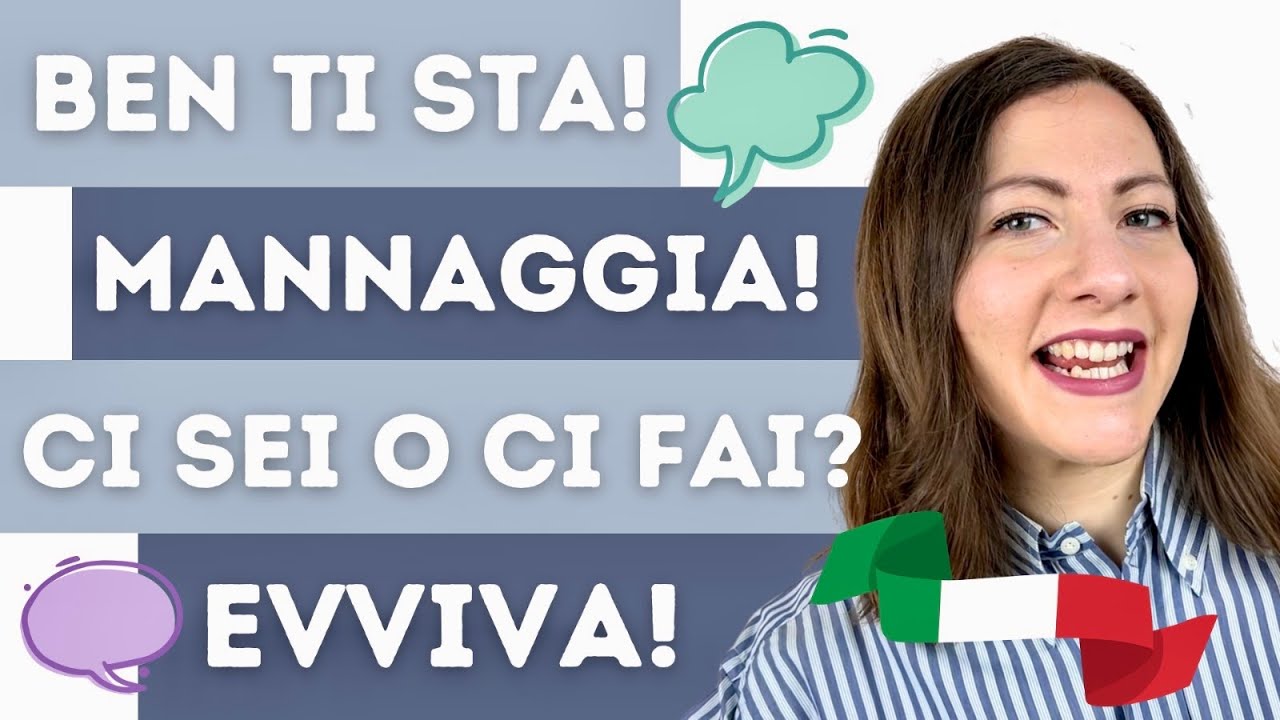
Let’s learn the MOST USED EXCLAMATIONS in ITALIAN
In this article, the topic will be EXCLAMATIONS: we will see which ones are the most popular in Italian, what they mean, and in which situations to use them!
1. BEN TI STA!
It means that the person to whom it is said deserves what has happened to them, usually in reference to negative things. It is often used when we had warned that person not to do something, and they did it anyway, resulting in negative consequences. It can also be said as “Ti sta bene!” with the exact same meaning.
Example:
A: I fell off the chair…
B: Ben ti sta! (It serves you right), I told you not to rock back and forth.
2.CI SEI O CI FAI?
It is used when someone is doing something foolish or inappropriate, and you’re asking them if they’re intentionally acting foolish or if they really are that way. It essentially means “are you purposely being foolish, or are you really like this?”
It can be used in a joking tone, but most of the time it’s used when one is annoyed by the person’s behavior. Therefore, it can sometimes be offensive if used inappropriately, almost like an insult.
Example:
1: Did you really think it was a good idea to throw a book at him? Ci sei o ci fai? (Are you kidding or are you serious?)
3. NON TI ALLARGARE!
This expression, very typical in central and southern Italy, has various nuances.
The first meaning is “don’t get too familiar,” used to make someone understand that they should maintain a certain distance because the relationship is not yet that intimate and familiar.
The second meaning is “don’t exaggerate,” used when someone is going overboard with what they say. There is also the variation “Non ci allarghiamo,” with the same meaning. It can be used in a joking, neutral, or brusque tone, depending on the situations.
Examples:
1: “Non ti allargare! (Don’t get too familiar), we’ve only known each other for a few minutes, it doesn’t seem appropriate to go out together.”
A: “I did an excellent job today, surely the boss will promote me soon!”
B: “Non ti allargare! (Don’t exaggerate now), you won’t get a promotion for so little.”
4. BEATO TE! (BEATA LEI! / BEATI VOI! …)
This exclamation means “How lucky you are!” In other words, it’s a common way to say “I wish I were in your shoes”
Examples:
A: Next month I’m going on vacation to the Maldives.
B: Beato te! (Lucky you) I can’t manage to take any trips this year.
5. DA CHE PULPITO!
Said to someone who is criticizing or reproaching us for our flaws, without realizing or admitting that they have the exact same flaws. So it is used with a person who behaves in a certain way but preaches the opposite.
Example:
A: Look how messy you are, you should be more careful about where you leave your things.
B: Da che pulpito! (Look who’s talking!) Your clothes are scattered all over the house.
6. EVVAI!
This is a good exclamation to express enthusiasm, joy, wish, exultation and approvation.
Esempio:
A: Look, there are swallows!
B: Evviva (Hooray!), spring has returned!
If you want to delve deeper, you can explore by learning Italian expressions to express enthusiasm!
7. ACCIDENTI!
It expresses opposition, anger, and rage, but also astonishment and admiration.
At times, it can also be used as an exclamation or curse. In this case, it is followed by the preposition “a” + the object of the curse.
Examples:
1. Accidenti! (Darn it!) I completely forgot about tomorrow’s appointment with the dentist.
2. Accidenti (Wow), you’re incredibly talented at playing the violin!
3. Accidenti a te! (Darn you), you scared me!
Stop reading Italian.
Start speaking it.
Online lessons in groups of 4, organised by level and goals, with qualified teachers. Pick the day and time that suit you from the available slots.
Max 4 students:
there’s a seat for you
8. A CHI LO DICI!
Literally, it means “To whom are you saying this?” but it is a rhetorical question that implies “I know it well!”, “It’s the same for me”, “I’m no exception”. It is used especially when someone complains about something sad, difficult, or unpleasant, and we want to make them understand that they are not the only one suffering, that we are also in the same situation!
Example:
A. I’m so stressed… I work every day and I never have a day off!
B. A chi lo dici! (Tell me about it!) I haven’t been on vacation for at least 4 years!”
9. FORZA E CORAGGIO!
Used when you want to encourage someone to do something or to keep doing something without giving up, like saying “Come on! You can do it with a little strength and courage!”
Example:
1. Only one kilometer left to the finish line, come on, Forza e coraggio ! (be strong and courageous) You’re almost there!
2. Forza e coraggio! (be strong and courageous), it’s your turn to wash the dishes today.
10. PER CARITÀ!
“Per carità!” (for God’s sake!) is used for express “please”, almost with a sense of supplication.
A. Francesca, would you come to Kenya for a safari?
B.Per carità (for God’s sake / Please!), i am too afraid of leons!
This is often used at the end of a sentence as an answer to express a strong dissens, or to refuse.
- Do you like Paolo?
- Per carità! (For God’s sake / Please!). He is such an annoying person that I prefer to completely avoid talking to him!
11. CHE PECCATO!
this is used To express regret or disappointment about something that happened or something that was supposed to happen but didn’t.
Example:
A: Today, i have to work late.
B: Che peccato! (What a shame!) I was hoping you could join us for an aperitif.
12. MANNAGGIA!
This is an exclamation of dissatisfaction, anger, rage, impatience, and regret. In short, it is used for negative things that we don’t like. When it takes on a shade of sadness and regret, it is synonymous with “What a shame!”
Examples:
A: I have to work late today
B: Mannaggia! (What a shame!) I was hoping you could join us for an aperitif.
A. Mannaggia! (Damn it!) I just missed my train!
B. I told you you should have woke up earlier!
13. MAMMA MIA!
An exclamation that can be both positive and negative, as it can express joy, surprise, but also anxiety and fear. It all depends on the intonation used as well.
Example:
While we were watching a horror film, we jumped in fright. Mamma mia! we were really scared.
I remind you that if you want to improve your Italian with individual lessons with me, you can do so on italki; just search for my name: Graziana Filomeno!
In the meantime, i suggest you to learn more about this topic visiting the others existing italian Exclamations.
Want the lesson PDF with exercises and solutions?
Join the LearnAmo AcademyCaricamento quiz in corso…
Podcast: Play in new window | Download (Duration: 15:28 — 18.1MB)
Iscriviti: Apple Podcasts | Spotify | Android | iHeartRadio | Podcast Index | TuneIn | Deezer | RSS | Altri...
What does ammapedi mean? Hope i spelled it right
Thank you