


How well do you know B1 level Italian vocabulary? In this article you will find fifteen essential words, each accompanied by a definition and useful explanations to understand their meaning and use in everyday life. For each word you will see the first letter and a description: try to guess before reading the answer!
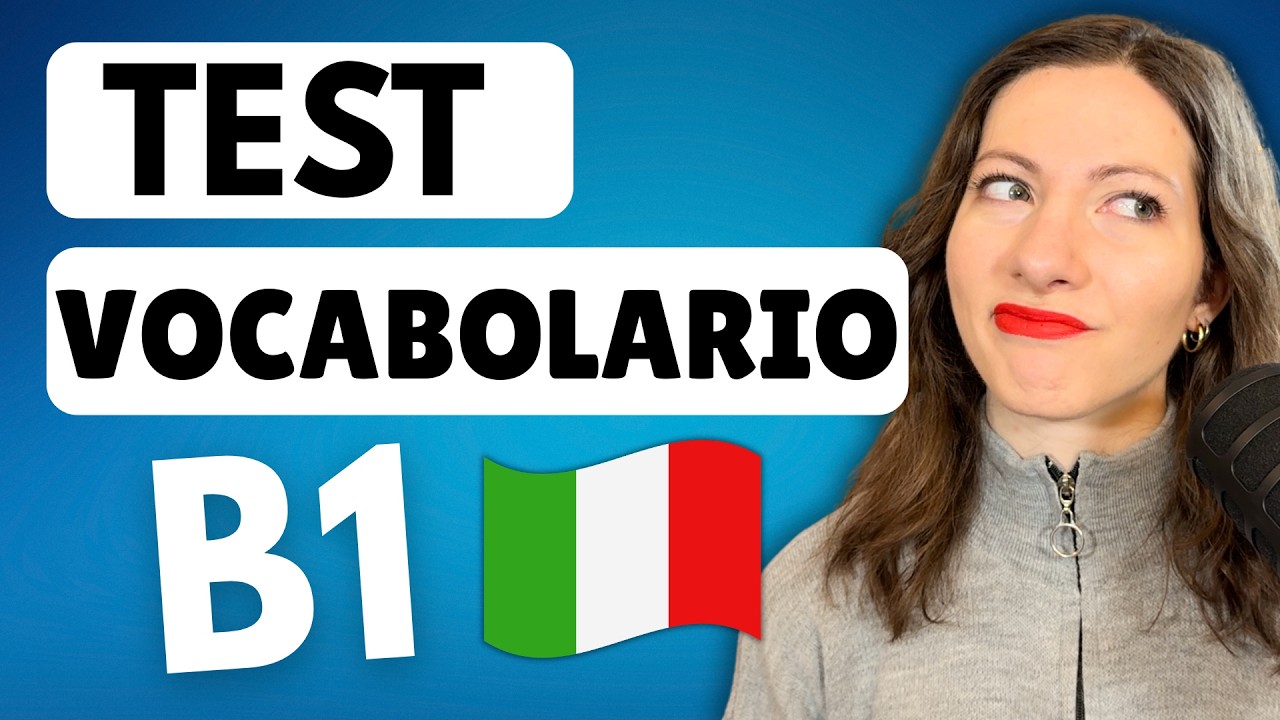
If You Know These Words, You Have an INTERMEDIATE Level
Word 1 – Letter P
This is a small object that you keep in your pocket or bag and that you use to store money and credit cards. What is it?
[…]
The answer is: portafoglio [wallet].
The portafoglio [wallet] is the object where we put money, credit cards, our driver’s license, membership cards… Be careful: “portafoglio” is a compound word made up of “porta” (from the verb “portare” [to carry]) and “foglio” [sheet]. Originally, it was used to carry sheets, meaning banknotes. Remember that it is masculine: il portafoglio.
Word 2 – Letter S
You use this thing to wash your hands. It has a nice scent and makes foam. What is it?
[…]
The answer is: sapone [soap].
We use sapone [soap] to wash our hands, but also to wash our body in the shower. There is sapone solido [bar soap], the classic brick-shaped one, and sapone liquido [liquid soap], which comes out of a dispenser. If the soap has a nice scent, we can say it is a sapone profumato [scented soap].
Word 3 – Letter R
This is a verb. It is the action of not forgetting something, of having something in your memory. What is the verb?
[…]
The answer is: ricordare [to remember].
“Ricordare” [to remember] means to have something in your memory.
Example: “Ricordo ancora la mia prima vacanza al mare” [I still remember my first vacation at the seaside]. The opposite is dimenticare [to forget]. You can say both “ricordo qualcosa” [I remember something] and “mi ricordo di qualcosa” [I remember about something], with a slight difference in nuance.
Word 4 – Letter B
This is a public place where you can borrow books for free. What is it?
[…]
The answer is: biblioteca [library].
The biblioteca [library] is a place where you can read and borrow books without paying. Be careful not to confuse “biblioteca” with “libreria”: the libreria [bookshop] is the shop where you buy books, the biblioteca [library] is where you borrow them. This is a very common mistake among Italian language students.
Word 5 – Letter B
This is a document that you receive at home and that you have to pay, for example for electricity, gas, or water. What is it?
[…]
The answer is: bolletta [utility bill].
The bolletta [utility bill] is that piece of paper (nowadays often digital) that tells you how much you have to pay for services like electricity, gas, water, phone… In Italy we often say “pagare le bollette” [to pay the bills] to refer to the fixed household expenses. And when the bills are very high, we say they are salate [salty]: in Italian, “salato” also means “expensive”.
Word 6 – Letter R
This adjective describes something or someone that makes a lot of noise. What is it?
[…]
The answer is: rumoroso [noisy].
Something rumoroso [noisy] is something that makes a lot of noise. Example: “I miei vicini di casa sono molto rumorosi, fanno sempre feste fino a tardi!” [My neighbors are very noisy, they always throw parties until late!]. The opposite of rumoroso is silenzioso [quiet]. Remember: the noun is “rumore” [noise], the adjective is “rumoroso” [noisy].
Word 7 – Letter S
This is a verb. It is the action of using your hands or body to move something forward. What is the verb?
[…]
The answer is: spingere [to push].
“Spingere” [to push] means to use force to move something forward. For example, we push a shopping cart at the supermarket or push a door to open it. The opposite is tirare [to pull].
On shop doors in Italy you often find the words “spingere” [push] or “tirare” [pull].
Pay attention to the past participle, which is irregular: spinto [pushed]. Example: “Ho spinto la porta, ma non si è aperta” [I pushed the door, but it didn’t open].
Word 8 – Letter M
This is the part of the street where pedestrians, people on foot, walk. What is it?
[…]
The answer is: marciapiede [sidewalk].
The marciapiede [sidewalk] is the raised part on the sides of the street where we pedestrians walk. It is a compound word: “marcia” (from the verb “marciare” [to march], meaning to walk) + “piede” [foot]. So, literally, it is the place where feet march. In Italy, walking on the sidewalk is essential because the streets are often narrow and cars pass very close by.
Word 9 – Letter G
This word describes the negative feeling you experience when you are afraid of losing a person you love, or when you envy someone. What is it?
[…]
The answer is: gelosia [jealousy].
Gelosia [jealousy] is that unpleasant feeling we experience when, for example, our partner talks with another person and we feel threatened. But “gelosia” can also mean invidia [envy]: Example: “Provo gelosia per il suo successo” [I feel jealous of his/her success]. The adjective is geloso/gelosa [jealous]: Example: “Sono geloso di te” [I am jealous of you]. It is a very human emotion, but be careful: too much jealousy is not good for relationships.
Word 10 – Letter I
This adjective describes something that is of no use, that has no utility. What is it?
[…]
The answer is: inutile [useless].
Something inutile [useless] is something that is of no use. Example: “È inutile chiamarlo, non risponde mai al telefono” [It’s useless to call him, he never answers the phone]. As you can see, in Italian we often form the opposite by adding the prefix “in-“ before the adjective: utile → inutile [useful → useless]. Other examples: felice → infelice [happy → unhappy], giusto → ingiusto [fair → unfair].
Word 11 – Letter P
This is a verb. It is the action of reserving in advance a table at a restaurant, a hotel room, or a ticket. What is the verb?
[…]
The answer is: prenotare [to book / to reserve].
“Prenotare” [to book] means to reserve something in advance. You can prenotare a table at a restaurant, a flight, a hotel, a doctor’s appointment… In Italy, especially at famous restaurants, it is very important to book, otherwise you risk not finding a seat. The noun is prenotazione [reservation/booking]: Example: “Ho fatto una prenotazione per due persone” [I made a reservation for two people].
Word 12 – Letter P
This adjective describes something that goes very far down, that has a great distance from the surface to the bottom. What is it?
[…]
The answer is: profondo [deep].
Something profondo [deep] has a great distance between the surface and the bottom. Example: “Il mare qui è molto profondo, non tocco!” [The sea here is very deep, I can’t touch the bottom!]. But “profondo” is also used in a figurative sense: un pensiero profondo [a deep thought], un’amicizia profonda [a deep friendship], un libro profondo [a profound book]. The opposite is superficiale [shallow/superficial], which is used both in a literal and figurative sense.
Word 13 – Letter G
This adjective describes a person who is polite, courteous, and who treats others with respect. What is it?
[…]
The answer is: gentile [kind / polite].
A gentile [kind] person is a polite, courteous person who has good manners. Example: “Il cameriere è stato molto gentile con noi” [The waiter was very kind to us]. In Italian, when you write a formal email, you often begin with “Gentile Signor/Signora…” [Dear Sir/Madam…]. The opposite of gentile can be scortese [rude] or maleducato [ill-mannered].
Word 14 – Letter L
This is a household appliance that you use to wash clothes. What is it?
[…]
The answer is: lavatrice [washing machine].
The lavatrice [washing machine] is the household appliance we use to wash clothes. “Lavatrice” comes from the verb “lavare” [to wash]. And the appliance that dries clothes? It is called asciugatrice [dryer]. In Italy, however, many people still prefer to hang their clothes out in the sun, on the balcony: it is more eco-friendly and the clothes smell wonderful.
Word 15 – Letter N
This adjective describes something or someone that is not interesting, that bores us. What is it?
[…]
The answer is: noioso [boring].
Something noioso [boring] is something that bores us, that does not interest us. Example: “Quel film era così noioso che mi sono addormentato!” [That movie was so boring that I fell asleep!]. You can also use “noioso” for people: Example: “Lui è un po’ noioso, parla sempre delle stesse cose” [He is a bit boring, he always talks about the same things]. The verb is annoiare [to bore] and the noun is noia [boredom]: Example: “Che noia questa lezione!” [How boring this lesson is!].
Summary Table of the 15 B1 Words
| N° | Parola [Word] | Tipo [Type] | Definizione [Definition] | Contrario / Nota [Opposite / Note] |
|---|---|---|---|---|
| 1 | Portafoglio [wallet] | Sostantivo (m.) [Noun (m.)] | Oggetto per conservare soldi e carte [Object for storing money and cards] | Parola composta: porta + foglio [Compound word: porta + foglio] |
| 2 | Sapone [soap] | Sostantivo (m.) [Noun (m.)] | Si usa per lavarsi, fa la schiuma [Used for washing, makes foam] | Solido / Liquido / Profumato [Solid / Liquid / Scented] |
| 3 | Ricordare [to remember] | Verbo [Verb] | Avere qualcosa nella memoria [To have something in one’s memory] | Contrario [Opposite]: dimenticare [to forget] |
| 4 | Biblioteca [library] | Sostantivo (f.) [Noun (f.)] | Luogo dove si prendono libri in prestito [Place where you borrow books] | ≠ Libreria (negozio) [≠ Bookshop (store)] |
| 5 | Bolletta [utility bill] | Sostantivo (f.) [Noun (f.)] | Documento di pagamento per servizi [Payment document for services] | “Salata” = costosa [“Salty” = expensive] |
| 6 | Rumoroso [noisy] | Aggettivo [Adjective] | Che fa molto rumore [That makes a lot of noise] | Contrario [Opposite]: silenzioso [quiet] |
| 7 | Spingere [to push] | Verbo [Verb] | Usare forza per muovere in avanti [To use force to move forward] | Contrario [Opposite]: tirare [to pull] – P.P.: spinto [pushed] |
| 8 | Marciapiede [sidewalk] | Sostantivo (m.) [Noun (m.)] | Parte rialzata della strada per i pedoni [Raised part of the street for pedestrians] | Parola composta: marcia + piede [Compound word: marcia + piede] |
| 9 | Gelosia [jealousy] | Sostantivo (f.) [Noun (f.)] | Sentimento di paura di perdere qualcuno [Feeling of fear of losing someone] | Aggettivo [Adjective]: geloso/a [jealous] |
| 10 | Inutile [useless] | Aggettivo [Adjective] | Che non serve a niente [That is of no use] | Contrario [Opposite]: utile [useful] (prefisso in-) [prefix in-] |
| 11 | Prenotare [to book] | Verbo [Verb] | Riservare qualcosa in anticipo [To reserve something in advance] | Sostantivo [Noun]: prenotazione [reservation] |
| 12 | Profondo [deep] | Aggettivo [Adjective] | Che ha molta distanza dalla superficie al fondo [That has great distance from the surface to the bottom] | Contrario [Opposite]: superficiale [shallow/superficial] |
| 13 | Gentile [kind] | Aggettivo [Adjective] | Educato, cortese [Polite, courteous] | Contrario [Opposite]: scortese / maleducato [rude / ill-mannered] |
| 14 | Lavatrice [washing machine] | Sostantivo (f.) [Noun (f.)] | Elettrodomestico per lavare i vestiti [Household appliance for washing clothes] | Simile [Similar]: asciugatrice [dryer] |
| 15 | Noioso [boring] | Aggettivo [Adjective] | Che non è interessante, che annoia [That is not interesting, that bores] | Verbo [Verb]: annoiare [to bore] – Sost. [Noun]: noia [boredom] |
Frequently Asked Questions
What Is the Difference Between “Biblioteca” and “Libreria”?
The biblioteca [library] is a public place where you can borrow books for free. The libreria [bookshop], on the other hand, is a shop where you buy books. This is one of the most common mistakes among Italian language students, because in many other languages (like the English “library”) the word resembles “libreria” but has the meaning of “biblioteca”.
What Does “Bolletta Salata” Mean in Italian?
When we say that a bolletta is “salata” [salty], we mean that it is very expensive. In Italian, the adjective “salato” has a double meaning: it indicates both something that contains a lot of salt and something that has a high price. Example: “Il conto del ristorante era davvero salato!” [The restaurant bill was really expensive!] means it was very pricey.
How Do You Form the Opposite of Adjectives With the Prefix “In-“?
In Italian, many adjectives form their opposite by adding the prefix “in-“ before the word. Here are some examples: utile → inutile [useful → useless], felice → infelice [happy → unhappy], giusto → ingiusto [fair → unfair]. Be careful: the prefix can change slightly depending on the initial letter of the adjective. Before “p” and “b” it becomes “im-“ (possibile → impossibile [possible → impossible]), before “l” it becomes “il-“ (legale → illegale [legal → illegal]), before “r” it becomes “ir-“ (regolare → irregolare [regular → irregular]).
What Is the Difference Between “Ricordo Qualcosa” and “Mi Ricordo di Qualcosa”?
Both forms are correct, but there is a slight nuance. “Ricordo qualcosa” [I remember something] (transitive use) is more direct and refers to the memory of a specific fact: Example: “Ricordo il tuo nome” [I remember your name]. “Mi ricordo di qualcosa” [I remember about something] (pronominal use) is more reflexive, emphasizing the mental process of remembering: Example: “Mi ricordo di quando eravamo piccoli” [I remember when we were little]. In everyday spoken language, the two forms are often used interchangeably.
What Are “Compound Words” in Italian?
Compound words (parole composte) are words formed by joining two or more existing words. In this article we saw two examples: portafoglio (porta + foglio = “carries sheets/banknotes”) and marciapiede (marcia + piede = “where feet march”). Italian is rich in compound words: cavatappi [corkscrew] (cava + tappi), aspirapolvere [vacuum cleaner] (aspira + polvere), lavastoviglie [dishwasher] (lava + stoviglie) are other very common examples in everyday life.
If you want to further test your knowledge, don’t forget to take a look at the Italian verbs quiz in the dedicated article.
Learn Italian with original-language content thanks to Lingopie, the streaming platform perfect for learning foreign languages.
Stop reading Italian.
Start speaking it.
Online lessons in groups of 4, organised by level and goals, with qualified teachers. Pick the day and time that suit you from the available slots.
Max 4 students:
there’s a seat for you
Loading quiz…
Podcast: Play in new window | Download (Duration: 21:16 — 19.5MB)
Iscriviti: Apple Podcasts | Spotify | Android | iHeartRadio | Podcast Index | TuneIn | Deezer | RSS | Altri...