


Do you know the difference between “impedire” [to prevent] and “ostacolare” [to hinder]? And why do we say “un bel libro” but “un bell’uomo”? And most importantly… why can’t you say “va a piovere” to talk about the future? If these questions give you a headache, you’re in the right place!
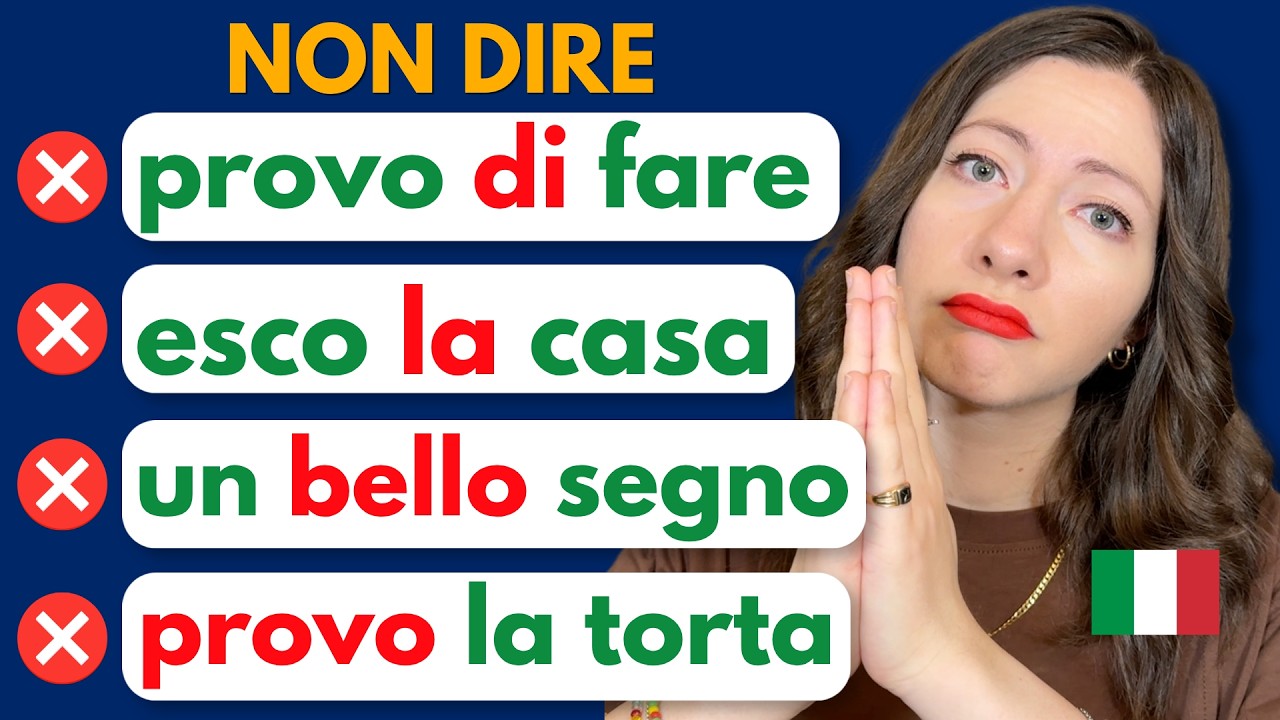
Avoid Making These Mistakes When You Speak Italian
1. IMPEDIRE [to prevent] vs OSTACOLARE [to hinder]
These two verbs seem similar, but there’s a fundamental difference that completely changes the meaning of the sentence.
IMPEDIRE [to prevent]: The Total Block
IMPEDIRE [to prevent] means to completely block, to make something impossible. When you use this verb, you indicate that the action did NOT happen, that there was a 100% total block.
Examples:
- “La neve ha impedito la partenza dell’aereo.” [The snow prevented the plane from departing.] → The plane did NOT leave. Impossible!
- “Il muro ci impedisce di vedere il mare.” [The wall prevents us from seeing the sea.] → We CANNOT see the sea. Zero possibility!
- “Mi hanno impedito di entrare.” [They prevented me from entering.] → I did NOT enter.
OSTACOLARE [to hinder]: The Surmountable Difficulty
OSTACOLARE [to hinder] means to make something more difficult, but not impossible. The action happens anyway, albeit with more effort or complications.
Examples:
- “La neve ha ostacolato il traffico.” [The snow hindered the traffic.] → There was traffic, but it was slow and difficult.
- “I problemi economici hanno ostacolato il progetto.” [The economic problems hindered the project.] → The project went ahead, but with difficulties.
- “Non voglio ostacolare i tuoi sogni.” [I don’t want to hinder your dreams.] → I don’t want to make them harder to achieve.
Why Is It Important Not to Confuse Them?
Because the communicated result is completely different! Let’s see a summary table:
| Verb | Meaning | Result |
|---|---|---|
| IMPEDIRE [to prevent] | To completely block | Does NOT happen (0%) |
| OSTACOLARE [to hinder] | To make difficult | Happens, but with difficulty |
Practical example: Imagine you want to go to a party:
- “Mia madre mi ha impedito di andare alla festa.” [My mother prevented me from going to the party.] → I didn’t go. My mother said NO and that’s it!
- “Mia madre ha ostacolato la mia uscita.” [My mother hindered my going out.] → I went to the party, but my mother created problems: she asked me a thousand questions, made me late, etc.
If you use “impedire” [to prevent] when you mean “ostacolare” [to hinder], you’re saying that something did NOT happen, when in fact it did happen!
2. The Adjective BELLO [beautiful]
The adjective BELLO [beautiful] is one of the most problematic for Italian students, but let’s try to clarify things once and for all.
The Golden Rule
The adjective BELLO [beautiful], when it comes before the noun, follows the same rules as the definite article. This is the key to never making mistakes.
| Article | Form of BELLO | Example |
|---|---|---|
| IL | BEL | “il libro → un bel libro” [the book → a beautiful book] |
| LO | BELLO | “lo spettacolo → un bello spettacolo” [the show → a beautiful show] |
| L’ | BELL’ | “l’uomo → un bell’uomo” [the man → a handsome man] |
| LA | BELLA | “la donna → una bella donna” [the woman → a beautiful woman] |
| L’ | BELL’ | “l’idea → una bell’idea” [the idea → a great idea] |
| I | BEI | “i libri → dei bei libri” [the books → some beautiful books] |
| GLI | BEGLI | “gli spettacoli → dei begli spettacoli” [the shows → some beautiful shows] |
| LE | BELLE | “le donne → delle belle donne” [the women → some beautiful women] |
Correct and Incorrect Forms
Correct:
• “Un bel libro” [A beautiful book] (like “il libro”)
• “Un bello spettacolo” [A beautiful show] (like “lo spettacolo”)
• “Un bell’uomo” [A handsome man] (like “l’uomo”)
• “Una bella casa” [A beautiful house] (like “la casa”)
• “Una bell’idea” [A great idea] (like “l’idea”)
Incorrect:
• “Un bello libro”
• “Uno bel spettacolo”
• “Uno bello spettacolo”
Why Is It Wrong to Say “Uno Bello Spettacolo”?
For two fundamental reasons:
1. The article “UNO” is only used before words that start with S + consonant, Z, GN, PS, X, Y.
“Bello” starts with B, so the article is “UN”, not “UNO”.
2. The form “BELLO” is only used before words that start with S + consonant, Z, GN, PS, X, Y (the same rules as “lo/uno”).
“Spettacolo” starts with SP (S + consonant), so we use “BELLO”.
Watch out! The article goes before “BELLO”, not before “spettacolo”! So:
“UN bello spettacolo” [A beautiful show] (UN + BELLO + spettacolo)
“UNO bello spettacolo” (The article depends on “bello”, which starts with B!)
| Sentence | Correct? |
|---|---|
| “Un bel spettacolo” [A beautiful show] | No |
| “Un bello spettacolo” [A beautiful show] | Yes |
| “Uno bel spettacolo” | No |
| “Uno bello spettacolo” | No |
Note: In informal spoken language, you might hear some Italians say “un bel spettacolo”. However, the grammatically correct form is “un bello spettacolo”.
3. ACCORGERSI [to realize] vs NOTARE [to notice]
Here’s another pair of verbs that creates a lot of confusion.
NOTARE [to notice]: Visual Observation
NOTARE [to notice] means to see, to observe something. It’s a conscious, voluntary action, mainly linked to visual perception:
Examples:
- “Ho notato che hai cambiato pettinatura.” [I noticed you changed your hairstyle.] → I saw, I observed the change.
- “Hai notato quel ragazzo al bar?” [Did you notice that guy at the bar?] → Did you see him? Did you observe him?
- “Non ho notato niente di strano.” [I didn’t notice anything strange.] → I didn’t see/observe anything strange.
ACCORGERSI [to realize]: The Realization
ACCORGERSI [to realize] means to realize something, often suddenly or after some time. It’s more linked to mental awareness than to sight:
Examples:
- “Mi sono accorto che avevo dimenticato il portafoglio.” [I realized I had forgotten my wallet.] → I realized, I became aware.
- “Non si è accorta di niente.” [She didn’t realize anything.] → She didn’t understand, she didn’t realize.
- “Ti sei accorto che Maria era triste?” [Did you realize that Maria was sad?] → Did you understand, did you realize she was sad?
The Nuances of Meaning
| Verb | Meaning | Domain |
|---|---|---|
| NOTARE [to notice] | To see with your eyes, to observe | Visual perception |
| ACCORGERSI [to realize] | To understand, to realize, to become aware | Mental awareness |
Clarifying example:
- “Ho notato che la porta era aperta.” [I noticed the door was open.] → I saw the door open. Simple observation.
- “Mi sono accorto che la porta era aperta.” [I realized the door was open.] → I realized something was wrong. Maybe at first I hadn’t paid attention, then I understood.
Watch Out for the Grammatical Construction!
NOTARE [to notice] + direct object (without preposition):
- “Ho notato il tuo nuovo taglio di capelli.” [I noticed your new haircut.]
- “Ho notato che sei stanco.” [I noticed that you’re tired.]
ACCORGERSI [to realize] + DI + something:
- “Mi sono accorto dell’errore.” [I realized the mistake.]
- “Mi sono accorto che sei stanco.” [I realized that you’re tired.]
- “Mi sono accorto l’errore.”
Important: If you use ACCORGERSI [to realize], don’t forget the preposition DI!
4. HA ATTERRATO vs È ATTERRATO [to land]
This mistake is very common: which auxiliary is used with the verb ATTERRARE [to land]? The answer is: it depends on the meaning.
Intransitive ATTERRARE [to land]: Auxiliary ESSERE
When ATTERRARE [to land] means to touch the ground, to land (for a plane, a bird, etc.), it’s intransitive and requires the auxiliary ESSERE:
Examples:
- “L’aereo è atterrato alle 15:30.” [The plane landed at 3:30 PM.]
- “L’aereo ha atterrato alle 15:30.”
- “L’elicottero è atterrato sul tetto.” [The helicopter landed on the roof.]
- “Siamo atterrati con un’ora di ritardo.” [We landed an hour late.]
Transitive ATTERRARE [to bring down]: Auxiliary AVERE
When ATTERRARE [to bring down] means to bring someone to the ground (in sports like wrestling, rugby, etc.), it’s transitive and requires the auxiliary AVERE:
Examples:
- “Il lottatore ha atterrato il suo avversario.” [The wrestler brought down his opponent.]
- “Il difensore ha atterrato l’attaccante in area.” [The defender brought down the attacker in the box.]
Why Is It Wrong to Say “L’Aereo Ha Atterrato”?
Because when we talk about a plane touching the ground, ATTERRARE [to land] is intransitive (it has no direct object). And intransitive verbs of movement or change of state in Italian use the auxiliary ESSERE:
Examples:
- “Sono arrivato.” [I arrived.] (not “ho arrivato”)
- “Sono partito.” [I left.] (not “ho partito”)
- “Sono atterrato.” [I landed.] (not “ho atterrato”)
The plane doesn’t “land something”. The plane simply lands. So: è atterrato.
| Use of ATTERRARE | Type | Auxiliary | Example |
|---|---|---|---|
| To touch the ground (plane) | Intransitive | ESSERE | “L’aereo è atterrato“ [The plane landed] |
| To bring to the ground (sports) | Transitive | AVERE | “Il lottatore ha atterrato l’avversario” [The wrestler brought down the opponent] |
5. USCIRE [to go out/leave] + Place: Watch Out for the Preposition!
This mistake is typical of English speakers (“to leave a place” without a preposition).
Incorrect and Correct Forms
Incorrect:
- “Sono uscito casa alle 8.”
- “Esco l’ufficio alle 17.”
- “Usciamo il ristorante?”
Correct:
- “Sono uscito da casa alle 8.” [I left home at 8.]
- “Esco dall’ufficio alle 17.” [I leave the office at 5 PM.]
- “Usciamo dal ristorante?” [Shall we leave the restaurant?]
Why Is the Preposition Needed?
Because in Italian the verb USCIRE [to go out/leave] is intransitive. This means that it CANNOT have a direct object. You can’t “leave something” directly. You must use a preposition:
USCIRE DA + place:
- “Esco dal cinema.” [I’m leaving the cinema.]
- “Esco dalla scuola.” [I’m leaving school.]
- “Esco dall’ufficio.” [I’m leaving the office.]
- “Esco da casa.” [I’m leaving home]
Watch out! It is also possible to hear the fixed expression “uscire di casa” (especially in some informal contexts). However, this occurs only with “casa”.
| Place | Preposition | Correct Example |
|---|---|---|
| Casa [home] | DA (o DI) | “Esco da (di) casa” [I’m leaving home] |
| Ufficio [office] | DA (+ article) | “Esco dall’ufficio” [I’m leaving the office] |
| Supermercato [supermarket] | DA (+ article) | “Esco dal supermercato” [I’m leaving the supermarket] |
| Scuola [school] | DA (+ article) | “Esco dalla scuola” [I’m leaving school] |
| Finestra [window] | DA (+ article) | “Esco dalla finestra” [I’m going out the window] |
6. CONVINCERE [to convince] vs PERSUADERE [to persuade]
These two verbs are very similar, but have an important nuance that distinguishes them:
CONVINCERE [to convince]: The Rational Approach
CONVINCERE [to convince] means to change someone’s mind using rational arguments, logic, evidence:
Examples:
- “L’ho convinto con i dati statistici.” [I convinced him with statistical data.] → I used numbers, facts, logical evidence.
- “Mi hanno convinto che avevo torto.” [They convinced me I was wrong.] → They made me understand, with arguments, that I was mistaken.
- “Come posso convincerti?” [How can I convince you?] → How can I make you understand that I’m right?
PERSUADERE [to persuade]: The Emotional Approach
PERSUADERE [to persuade] means to change someone’s mind using emotions, charm, insistence:
Examples:
- “Mi ha persuaso con il suo sorriso.” [He/She persuaded me with his/her smile.] → His/Her smile made me give in.
- “Alla fine mi hanno persuaso ad andare alla festa.” [In the end they persuaded me to go to the party.] → They insisted, they made me want to go.
- “È molto persuasivo quando parla.” [He’s very persuasive when he speaks.] → He knows how to touch people’s emotions.
The Two Strategies Compared
| Verb | Tool | Domain |
|---|---|---|
| CONVINCERE [to convince] | Logic, reason, evidence, data | HEAD |
| PERSUADERE [to persuade] | Emotions, charm, insistence | HEART |
Practical example:
- “Il venditore mi ha convinto a comprare l’auto mostrandomi le caratteristiche tecniche e il prezzo competitivo.” [The salesman convinced me to buy the car by showing me the technical features and competitive price.] → Rational arguments: data, numbers, facts.
- “Il venditore mi ha persuaso a comprare l’auto: era così simpatico e entusiasta!” [The salesman persuaded me to buy the car: he was so nice and enthusiastic!] → Emotions: friendliness, enthusiasm, personal charm.
Note: In everyday language, many Italians use these verbs as synonyms. So it’s not a serious mistake to confuse them! But if you want to be precise and refined, now you know the difference.
The Grammatical Construction
The grammatical construction is the same for both verbs:
- CONVINCERE [to convince] qualcuno A fare qualcosa / CHE + sentence
- PERSUADERE [to persuade] qualcuno A fare qualcosa / CHE + sentence
Examples:
- “L’ho convinto a venire.” [I convinced him to come.]
- “L’ho persuaso a venire.” [I persuaded him to come.]
- “L’ho convinto che era la scelta giusta.” [I convinced him that it was the right choice.]
- “L’ho persuaso che era la scelta giusta.” [I persuaded him that it was the right choice.]
Stop reading Italian.
Start speaking it.
Online lessons in groups of 4, organised by level and goals, with qualified teachers. Pick the day and time that suit you from the available slots.
Max 4 students:
there’s a seat for you
7. TENTARE [to attempt] vs PROVARE [to try] vs ASSAGGIARE [to taste]
Here are three verbs that are often confused, especially by English-speaking students.
TENTARE [to attempt]: The Difficult Effort
TENTARE [to attempt] means to try to do something difficult, often without success or with little hope:
Examples:
- “Ho tentato di aprire la porta, ma era bloccata.” [I tried to open the door, but it was stuck.] → I tried, I made an effort, but I didn’t succeed.
- “Tenterò di arrivare in tempo.” [I’ll try to arrive on time.] → I’ll do my best, but I’m not sure I’ll make it.
- “Ha tentato la fuga.” [He attempted to escape.] → He tried to escape, probably without success.
PROVARE [to try]: The Versatile Verb
PROVARE [to try] is more general and has different meanings:
1. To try to do something (similar to “tentare”, but more neutral):
- “Prova ad aprire la finestra.” [Try to open the window.]
- “Ho provato a chiamarti, ma non rispondevi.” [I tried to call you, but you weren’t answering.]
2. To test, to experience something:
- “Hai provato questo ristorante nuovo?” [Have you tried this new restaurant?]
- “Voglio provare la macchina prima di comprarla.” [I want to test drive the car before buying it.]
- “Prova questo vestito!” [Try on this dress!]
3. To feel an emotion:
- “Provo una grande gioia.” [I feel great joy.]
- “Cosa provi per lui?” [What do you feel for him?]
ASSAGGIARE [to taste]: The Taste
ASSAGGIARE [to taste] means to eat or drink a small amount to taste the flavor:
Examples:
- “Vuoi assaggiare la mia torta?” [Do you want to taste my cake?]
- “Ho assaggiato il vino: è buonissimo!” [I tasted the wine: it’s delicious!]
- “Assaggia questa pasta, dimmi se c’è abbastanza sale.” [Taste this pasta, tell me if there’s enough salt.]
Summary Table
| Verb | Main Meaning | Example |
|---|---|---|
| TENTARE [to attempt] | To try to do something difficult | “Ho tentato di convincerlo.” [I tried to convince him.] |
| PROVARE [to try] | To try to do / to test / to feel | “Prova questo gioco!” [Try this game!] |
| ASSAGGIARE [to taste] | To eat/drink a bit to taste the flavor | “Assaggia il sugo!” [Taste the sauce!] |
Common Mistakes to Avoid
- “Vuoi tentare la mia torta?” (Attempt the cake? What does that mean? Do you want to fight against the cake?)
- “Vuoi assaggiare la mia torta?” [Do you want to taste my cake?] (= Do you want to eat a little piece?)
- “Ho assaggiato di chiamarti.” (Taste a phone call? That makes no sense!)
- “Ho provato a chiamarti.” [I tried to call you.] (= I attempted to call you.)
Attention English speakers! In English “to try” can mean both “provare” [to try] and “assaggiare” [to taste] (“try this cake!”). But in Italian they are two different verbs! If you’re talking about food or drinks and want to say “taste the flavor”, use ASSAGGIARE [to taste].
8. “ANDARE A + Infinitive” [to go + infinitive] Is NOT the Future!
This mistake is very typical of Spanish or English speakers. It’s one of the most widespread and hardest errors to correct.
The Linguistic Transfer Error
In Spanish, “va a llover” means “it will rain” (future), just as in English we say “it’s going to rain“.
But in Italian? NO!
Incorrect:
- “Domani va a piovere.”
- “Questo film va a essere interessante.”
- “Domani vado a avere 30 anni.”
Correct:
- “Domani pioverà.” / “Domani piove.” [Tomorrow it will rain.] (present with future value)
- “Questo film sarà interessante.” [This movie will be interesting.]
- “Domani compirò 30 anni.” / “Domani compio 30 anni.” [Tomorrow I’ll turn 30.]
Why Is It Wrong?
Because in Italian “andare a + infinitive” [to go + infinitive] literally means to move toward a place to do something. There’s actual physical movement!
Examples:
- “Vado a mangiare al ristorante.” [I’m going to eat at the restaurant.] → I move, I go to the restaurant to eat there.
- “Vado a dormire.” [I’m going to sleep.] → I move toward the bed to sleep.
In these sentences, “andare” [to go] keeps its meaning of movement. It is NOT a construction to express the future!
When there is no physical movement, the construction doesn’t work:
- “Va a piovere.” (The rain doesn’t “go” anywhere!)
- “Il film va a essere bello.” (The movie doesn’t move!)
- “Vado a avere fame.” (You don’t move toward hunger!)
How Is the Future Expressed in Italian?
1. Simple future:
- “Domani studierò tutto il giorno.” [Tomorrow I’ll study all day.]
- “L’anno prossimo andremo in Giappone.” [Next year we’ll go to Japan.]
- “Domani pioverà.” [Tomorrow it will rain.]
2. Present indicative (very common in spoken Italian):
- “Domani studio tutto il giorno.” [Tomorrow I study all day.]
- “L’anno prossimo andiamo in Giappone.” [Next year we go to Japan.]
- “Domani piove.” [Tomorrow it rains.]
Comparison Table
| Sentence | Meaning | Correct? |
|---|---|---|
| “Vado a mangiare al ristorante.” [I’m going to eat at the restaurant.] | I move toward the restaurant to eat | Yes (there’s movement) |
| “Stasera mangio fuori.” [Tonight I eat out.] | Tonight I’ll eat out (future) | Yes |
| “Domani va a piovere.” | Tomorrow it will rain | No (the rain doesn’t move!) |
| “Domani pioverà.” [Tomorrow it will rain.] | Future | Yes |
Practical example:
- “Vado a comprare il pane.” [I’m going to buy bread.] → I move, I leave the house, I go to the store to buy bread. There’s movement!
- “Il pane va a costare di più.” (The bread will cost more? NO! The bread doesn’t “go” anywhere!)
- “Il pane costerà di più.” [The bread will cost more.]
In short: “Andare a + infinitive” [to go + infinitive] = physical movement toward a place to do something.
For the future without movement, use the simple future or the present indicative.
Frequently Asked Questions
Can I Use “Impedire” [to prevent] and “Ostacolare” [to hinder] as Synonyms?
No, because they communicate opposite results. “Impedire” [to prevent] indicates that something did NOT happen (total block), while “ostacolare” [to hinder] indicates that it happened with difficulty. Using them as synonyms completely changes the meaning of the sentence.
Why Do Some Italians Say “Un Bel Spettacolo” Instead of “Un Bello Spettacolo”?
In informal spoken language, this simplification is common. However, the grammatically correct form remains “un bello spettacolo” because “spettacolo” [show] starts with S + consonant, requiring the form “bello” (like the article “lo”).
What’s the Difference Between “Ho Notato” [I noticed] and “Mi Sono Accorto” [I realized]?
“Ho notato” [I noticed] indicates a conscious visual observation, while “mi sono accorto” [I realized] indicates a realization, often sudden. “Notare” [to notice] is linked to sight, “accorgersi” [to realize] to mental understanding.
Why Do I Have to Say “Esco di Casa” [I leave home] but “Esco dal Cinema” [I leave the cinema]?
“Uscire di casa” [to leave home] is a fixed idiomatic expression that has crystallized over time. With all other places, “da” + article is regularly used. It’s one of the many exceptions that characterize the Italian language.
Are “Convincere” [to convince] and “Persuadere” [to persuade] Really Different?
Yes, although in everyday language they are often used as synonyms. “Convincere” [to convince] implies the use of logic and rational arguments, while “persuadere” [to persuade] implies the use of emotions and personal charm. If you want to be precise, this distinction is important.
Why Can’t I Say “Va a Piovere” Like in Spanish or English?
Because in Italian “andare a + infinitive” [to go + infinitive] keeps the literal meaning of physical movement. It hasn’t developed as a grammatical construction for the future like in Spanish (“ir a”) or in English (“going to”). To express the future, use the simple future or the present indicative.
When Do I Use “Provare” [to try] and When “Assaggiare” [to taste]?
Use “assaggiare” [to taste] exclusively when talking about eating or drinking something to taste its flavor. Use “provare” [to try] to test something (clothes, cars, restaurants) or to try to do something. “Tentare” [to attempt] is used when the action is particularly difficult or with low chances of success.
Ready to discover more mistakes you might still be making? Read the article dedicated to another 7 common mistakes.
Do you want to take Italian lessons with our qualified native teachers? Purchase your Italiano Intensivo package!
Want the lesson PDF with exercises and solutions?
Join the LearnAmo AcademyLoading quiz…
Podcast: Play in new window | Download (Duration: 31:46 — 29.1MB)
Iscriviti: Apple Podcasts | Spotify | Android | iHeartRadio | Podcast Index | TuneIn | Deezer | RSS | Altri...