


Today we will see a “scary” lesson, a topic that frightens every student of the Italian language… the PRONOUN VERBS! All you need is paper and pen (or the notes of your smartphone!): we think you will have to take notes!
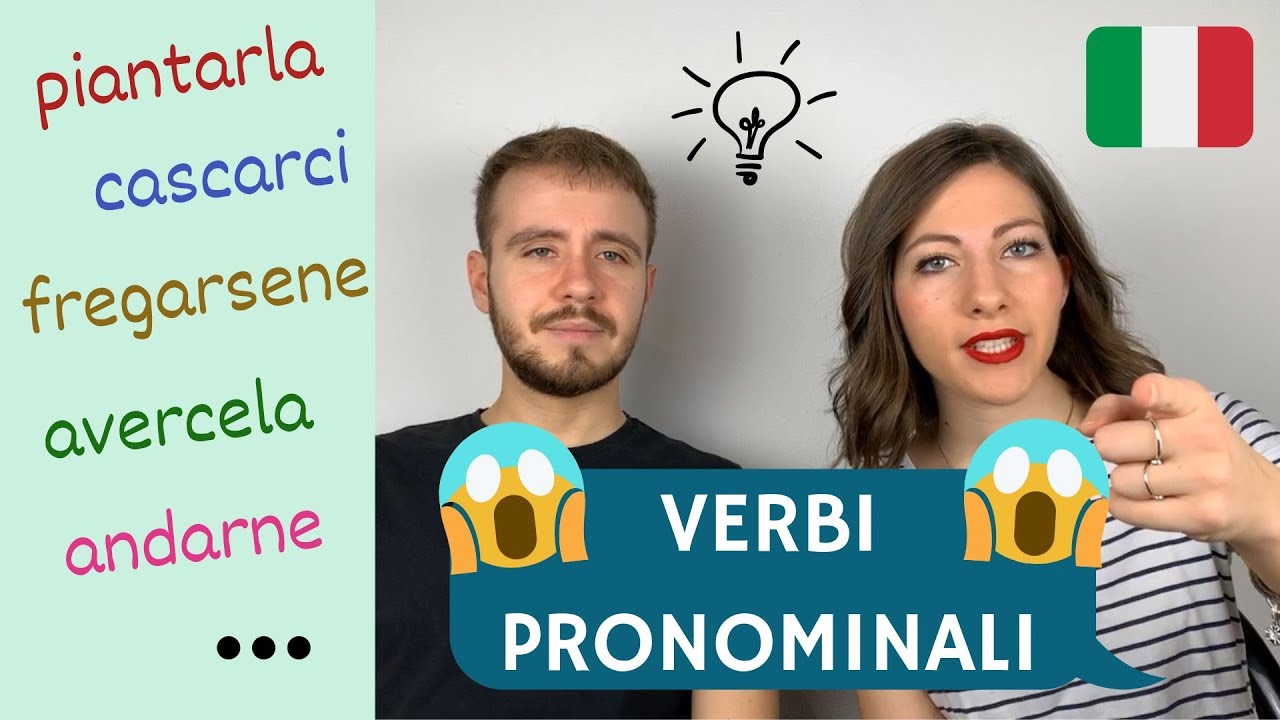
Italian VERBI PRONOMINALI: definition and examples
What are “verbi pronominali” or “pronoun verbs” in Italian? The “verbi pronominali” are those verbs including a pronoun in their infinitive form.
Since it is a very wide and complex topic, we decided to make it clearer by subdividing these verbs into classes.
First class: verbs in –la
– PIANTARLA
If you’re thinking that this verb means “to put a seed or a plant in the soil”… then you’re getting confused with the verb “piantare (to plant)” (example: Io pianto i tulipani ogni anno → I plant tulips every year).
“PIANTARLA”, instead, means “to stop doing or saying something”.
For example:
Spero che il nostro vicino la pianti con questa musica! Devo studiare! (I hope our neighbor will stop it with this music! I have to study!)
N.B. Very often, Italians use it as an imperative in order to make someone stop bothering: “Piantala!”
– FINIRLA / SMETTERLA
“To stop doing something, especially something annoying“.
For example:
Finiscila / Smettila con le tue lamentele! (Stop it with your complaints!)
– FARLA
“To get the better of someone, generally by deceit and with cunning“.
For example:
Marco sa mentire davvero bene! Me l’ha fatta anche questa volta! (Marco can lie very well! He got the better of me once again!)
– SPUNTARLA
“To be able to get what you want by overcoming obstacles and difficulties“.
For example:
Nella riunione Marco era l’unico contrario ma alla fine, non so come, l’ha spuntata! (During the meeting, Marco was the only one to be against, but at the end, I don’t know why, he won!)
– FARLA FRANCA
“To be able to avoid the consequences of a mistake or a bad action: not to get caught“.
For example:
Dopo aver rapinato la banca, i ladri sono riusciti a farla franca fuggendo con un motorino. (After they robbed the bank, the thieves were able to get away with it by escaping with a scooter)
Second class: verbs in –ci
We have already talked about some of these verbs, such as:
– ENTRARCI
Generally used in formulas like “non c’entra niente” (C’entrare or centrare? Watch our video!)
– METTERCI and VOLERCI
Used – and confused – with a time-related meaning (Ci vuole or ci mette?)
– ESSERCI and STARCI
In this respect, don’t miss our funny video ESSERE vs STARE!
But there are also:
– ANDARCI
“To be appropriate; to fit.” o “To adapt, to get in there“.
For example:
In questa cucina ci andrebbe un bel tappeto rosso! (In this kitchen a red rug would fit)
Non serve continuare a provare: la valigia là non ci va! (Stop trying: the suitcase can’t get there!)
– ARRIVARCI
“Understand“.
For example:
La bottiglia dell’acqua vuota deve andare nel contenitore della plastica, non in quello della carta! Ma proprio non ci arrivi? (The empty bottle of water should be put in the container for plastic, not in that for paper! Don’t you get it?)
– CASCARCI
“Cascare”, in its basic form, means “to fall down” (example: Paola è cascata dalle scale mentre portava le buste → Paola fell down the stairs while she was bringing the bags)…
However, the pronoun verb “CASCARCI” has the meaning “to get cheated; to be tricked”.
For example:
Nonostante fosse una fake news, tutti ci sono cascati. (Although it was fake news, everyone fell for it)
– PERDERCI
“To suffer a damage, especially financial” or “To lose in beauty, in value“.
For example:
Se compri le azioni di quella compagnia, ci perdi! Io ti ho avvisato… (If you buy the stocks of that company, you’ll lose money! I warned you!)
– RIMETTERCI
“To lose“.
For example:
Con questo freddo non puoi uscire in pantaloncini! Non vorrai mica rimetterci la salute?! (With this cold you can’t go out in shorts! You don’t want to get sick, do you?)
What does “mica” mean? Find it out with us!
– SCAPPARCI
“To be possible, viable” or “To happen disgracefully“.
For example:
Se le cose tra loro continuano così, è probabile che prima o poi ci scappi un morto! (If things among them continue to be like that, it’s highly likely that sooner or later someone will die!)
Comportati bene con il capo, così magari ci scappa l’aumento! (Behave well with the boss. He might give you an increase in the wage)
– SENTIRCI
“To have the sense of hearing in good condition“.
For example:
Nonostante mia nonna abbia 90 anni, ci sente ancora benissimo! (Although my granny is 90 years old, she still hears very well!)
– VEDERCI
“To have the sense of seeing in good condition” (to give emphasis).
For example:
Sto diventando vecchio: ormai ci vedo solo con gli occhiali! (I’m getting old: I can only see with the glasses now!)
– PROVARCI
“To try a sexual approach with someone“.
For example:
Paolo è un dongiovanni: ci prova con tutte le ragazze che incontra! Non si stanca mai! (Paolo is a playboy: he flirts with all the girls he meets! He never gets tired!)
Third class: verbs in –si
The verbs in -si generally change the reflexive pronoun according to the subject.
Among these, we can mention:
– VERGOGNARSI
“To feel ashamed; to be very shy“.
For example:
Luisa si vergogna di parlare con i ragazzi: per questo è ancora single. (Luisa is ashamed of talking with boys: for this reason she’s still single)
Some verbs in -si also have a basic form. By adding -si the verb takes a reflexive or reciprocal connotation.
Among these we can mention:
– LAVARE and LAVARSI
For example:
Noi laviamo la macchina MA Noi ci laviamo (We wash the car BUT We wash ourselves)
– PARLARE and PARLARSI
For example:
Paolo parla con sua madre (Paolo speaks with his mother) MA Paolo e Carla si parlano (Paolo and Carla speak with each other)
Stop reading Italian.
Start speaking it.
Online lessons in groups of 4, organised by level and goals, with qualified teachers. Pick the day and time that suit you from the available slots.
Max 4 students:
there’s a seat for you
Fourth class: verbs in –ne
– ANDARNE
Everybody knows the meaning of the verb “andare” (ANDARE vs VENIRE), but “ANDARNE” has a completely different meaning: “to be at stake”.
For example:
Non andate mai in moto senza casco! Ne va della vostra vita! (Don’t ride the motorbike without helmet! Your life is at stake!)
– FARNE (di tutti i colori / di cotte e di crude)
“To make a lot of mistakes; to make troubles“.
For example:
Ora è calmo, ma quando era piccolo, Luca ne faceva di tutti i colori! (Now he’s calm, but when he was little, Luca was up to all sorts of things)
Fifth class: verbs in –sela
– PRENDERSELA
We all know the meaning of “prendere”, that is “to take something”…
“PRENDERSELA”, instead, means “to be offended or to get angry at someone for something”.
For example:
Sono un po’ permalosa: me la prendo quando qualcuno mi offende o mi fa uno scherzo. (I am a little bit touchy: I get angry when someone insults me or makes me a joke)
– CAVARSELA
“To get out of a dangerous situation in a lucky way” or “To overcome the difficulties with cunning” or “To be good at something“.
For example:
Dopo l’incidente in moto, Luca se l’è cavata per miracolo! (After the motorcycle accident, Luca came through miraculously)
Non avevo studiato niente per l’esame, ma ho inventato tutto e me la sono cavata. (I didn’t study anything for the exam, but I invented everything and I managed it)
Sono un disastro con il tedesco! Con l’inglese, invece, me la cavo. (I’m terrible at German, but I’m good at English)
– CERCARSELA
“To behave in such a way to cause something damaging or unpleasant to yourself, something that could have been foreseen and avoided“.
For example:
La moglie di Paolo lo ha lasciato e ora lui è triste. Però se l’è cercata: la tradiva praticamente ogni mese con una donna diversa! (Paolo’s wife left him and now he’s sad. But he was asking for it: he basically cheated on her every month with a different woman!)
– DARSELA / FILARSELA
“To run away, to disappear, especially to avoid a difficult, annoying or uncomfortable situation“.
For example:
Quando ha capito che stava per essere scoperto, se l’è data / se l’è filata e nessuno ha più saputo nulla di lui per mesi. (When he realized he was about to be discovered, he run away and nobody heard news of him for months)
– FARSELA (con qualcuno)
“To hang out with someone regularly” or “To date someone“
For example:
Il figlio di Roberta se la fa con i peggiori criminali della città! (Roberta’s son hangs out with the worse criminals of the city!)
L’avvocato Rossi se la fa con la sua segretaria. (The attorney Rossi dates his secretary)
– PASSARSELA
“To live an existence“.
For example:
Da quando ha vinto la lotteria, Piero se la passa proprio bene! Ha anche comprato una casa con la piscina! (Since he won the lottery, Piero is doing good! He also bought a house with the pool!)
– SBRIGARSELA
“To solve a complicated situation in a short time“.
For example:
Ho detto al mio avvocato del nostro problema con l’affitto: ha detto che se la sbriga lui! (I told my lawyer about our problem with the rent: he told me he will handle it!)
– SPASSARSELA
“To spend time happily; to live the good life; to have a lot of fun“.
For example:
Dal momento che Luigi è milionario, i suoi figli se la spassano senza dargli una mano. (Since Luigi is a millionaire, his sons have a good time without helping him)
– SVIGNARSELA
“To go away without making other people notice“.
For example:
Che noia questa riunione! Appena posso me la svigno! (How boring this lesson is! As soon as I can, I’ll slip away)
– TIRARSELA
“To be full of oneself; to have a superior attitude“.
For example:
La fidanzata di Stefano è davvero antipatica! Non parla con nessuno e se la tira un sacco! (Stefano’s girlfriend is very unpleasant! She doesn’t speak with anybody and she brags a lot!)
Sixth class: verbs in –cela
– FARCELA
“To succeed, to carry out something“. N.B. Here “ce” doesn’t change.
For example:
Gianni ce l’ha fatta! Ha passato finalmente il test di guida! (Finally Gianni succeeded! He passed his driving test!)
N.B. The expression “Non ce la faccio più!” is very used to indicate that a situation has become intolerable.
– AVERCELA
“To be mad at someone“.
For example:
Perché non rispondi ai messaggi di Sara? Ce l’hai ancora con lei per quella vecchia storia? (Why don’t you answer Sara’s messages? Are you still mad at her for that old story?)
BE CAREFUL!
Keep in mind that all those verbs containing the pronoun “-la”, in the compound tenses, must agree with “-la” in gender and number!
For this reason, we won’t say:
“Il nostro vicino l’ha piantato di sentire musica ad alto volume” BUT “Il nostro vicino l’ha piantata di sentire musica ad alto volume“
Seventh class: verbs in –sene
– FREGARSENE
The basic form of this verb, that is “fregare” means “to steal something” or “to trick someone”.
While “FREGARSENE” means “not to worry, to feel indifference for something”.
Both are used only in the everyday and informal language.
For example:
Loro ci hanno detto che siamo brutti, ma noi ce ne siamo fregati. (They told us we are ugly, but we didn’t care)
A classical expression with this verb is “Chi se ne frega!” to show complete disregard for something.
– ANDARSENE
“To leave the place in which you are; to walk away; to leave for an unknown place“.
For example:
Dopo che abbiamo litigato, Luigi se n’è andato e non l’ho visto per mesi. (After we argued, Luigi walked away and I didn’t see him for months)
– INTENDERSENE
“To have full knowledge or experience in a specific field“.
For example:
Si è rotto il computer, quindi ho chiamato Sergio per aiutarmi. Lui se ne intende di informatica. (My computer broke, so I called Sergio to help me. He knows about IT)
– INFISCHIARSENE
“Not to care about anything or anyone“.
For example:
Oggi me ne infischio della dieta! Mangio le patatine fritte! (Today I don’t care about my diet! I’ll eat French fries!)
Eighth class: verbs in –cene
– VOLERCENE
Everybody knows the meaning of “volere”, we made a video about “volerci“, but what about “VOLERCENE”? What does it mean?
This verb is generally used in esclamative expressions with the meaning “a lot of time or effort is needed“.
For example:
Luigi è molto testardo: ce ne vuole per convincerlo! (Luigi is very stubborn: a significant effort is needed to convince him!)
Abbiamo finito quel progetto… ma ce n’è voluto! (We finished that project… but it took us a lot of time!)
– CORRERCENE
“To elapse a huge difference“.
For example:
Si sa: tra il libro e il film ce ne corre! In due ore non si può racchiudere tutto il significato di un intero libro! (Everyone knows: a lot elapse among the book and the film! In two hours you cannot enclose all the meaning of an entire book!)
Learn all the Italian pronominal verbs with clear examples and simple explanations! From the basic level (andarsene, cavarsela, piantarla, etc.) to the advanced level (svignarsela, vedersela brutta, avercela con, etc.), our complete course on pronominal verbs will help you understand their meaning and use them correctly in any context.
Want the lesson PDF with exercises and solutions?
Join the LearnAmo AcademyLet’s see if you’ve mastered the contents of this class. Have a go at completing the exercises!
Caricamento quiz in corso…
Podcast: Play in new window | Download (Duration: 9:53 — 9.0MB)
Iscriviti: Apple Podcasts | Spotify | Android | iHeartRadio | Podcast Index | TuneIn | Deezer | RSS | Altri...