


In this article, we’ll talk about the words “migliore” and “meglio”, which are very often used in Italian. I’m sure that you’ve asked yourself, at least once, what’s the difference between these two terms and in which situations we have to use one instead of the other. LearnAmo is here to help you clear up any doubt.
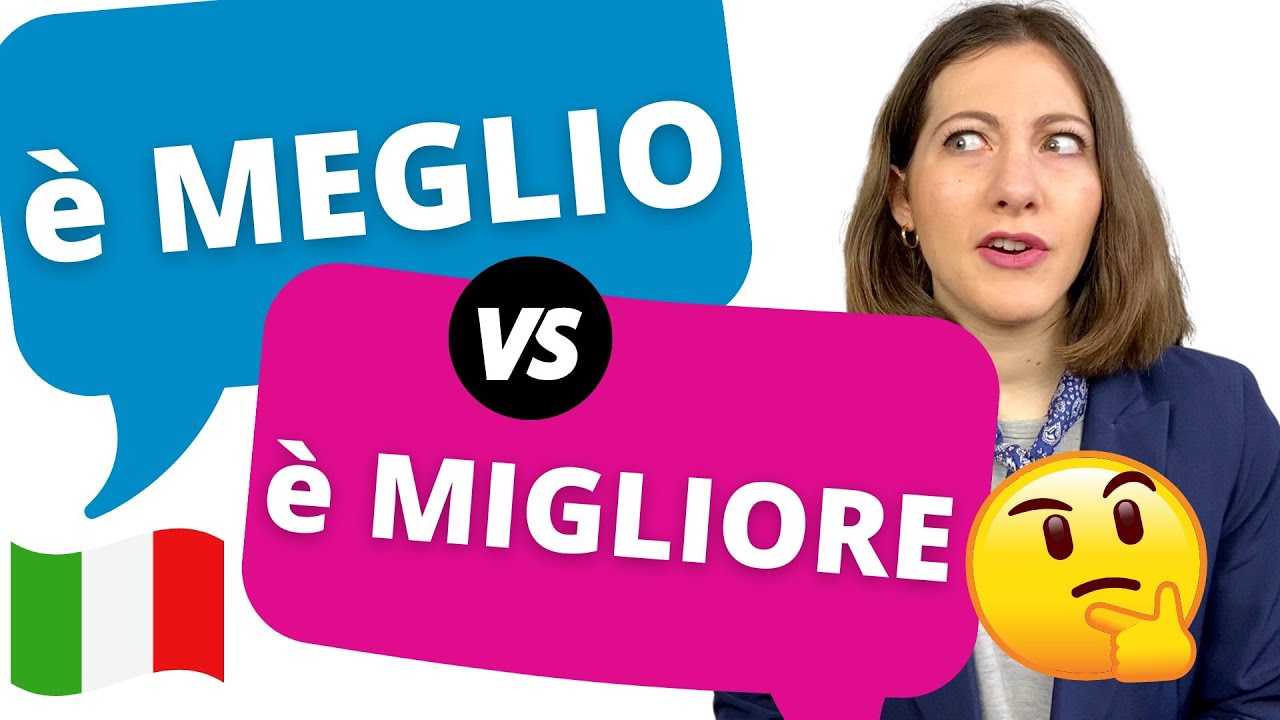
The difference between MIGLIORE and MEGLIO
MIGLIORE
Let’s start from the basics:
“Migliore” is an adjective (aggettivo qualificativo), so it’s used with nouns to describe their qualities. It’s the comparative form (forma comparativa di maggioranza) of the adjective buono (good).
The adjectives that come from “buono” are irregular:
buono (positive) – migliore (to compare) – ottimo (superlative)
In Italian, the adjective “migliore” is always the same, meaning that it doesn’t change in the feminine or masculine form; the plural is “migliori”, and again, it’s the same for masculine and feminine. Let’s see an example:
Questa giacca è migliore di quella perché è di cotone.
(This jacket is better than the other one because it’s made of cotton)
La pizza napoletana, secondo me, è migliore di quella romana.
(Neapolitan pizza, according to me, is better than the one from Rome)
Then, if we add the article “il” before “migliore”, it will become a relative superlative (like “the best”). Let’s see some more examples:
In quel ristorante fanno la pizza migliore della città.
(In that restaurant they make the best pizza in town)
Casa propria è il posto migliore del mondo.
(One’s house is the best place in the world)
Il cane è il miglior amico dell’uomo.
(Dogs are a man’s best friend)
In questa trasmissione vengono premiati i migliori pasticceri d’Italia.
(In this show we award the best bakers in Italy)
In some cases, the adjective “migliore” can become a noun, this is the most common case:
Grazie, sei il migliore!
(Thank you, you’re the best!)
MEGLIO
“Meglio” instead, is an adverb, so it’s always used with a verb. It’s the comparative form of the adverb bene (well).
The adverbs that come from “bene” are irregular:
bene (positive) – meglio (to compare) – ottimamente / benissimo (superlative)
The adverb “meglio” literally means “in a better way”. Here are some examples:
Se non avete capito, provate a rileggere meglio.
(If you did’t understand, try to read better)
Maria sa parlare portoghese molto meglio di me.
(Maria can speak Portuguese better than me)
And you may ask: is that all? Is it that simple?
Well…not really
CAN THEY BE USED INTERCHANGABLY?
In colloquial and spoken Italian, we tend to use the adverb “meglio” instead of “migliore”, so we use it as an adjective, even if it’s actually an adverb.
So you’ll find that, in fact, the word “meglio” is a lot more common in spoken colloquial Italian compared to “migliore”. Let’s see some examples in which this happens:
Come calciatore, Giacomo è meglio di suo fratello.
(As a football player, Giacomo is better than his brother)
Ho notato che il tuo tedesco è molto meglio rispetto a qualche mese fa.
(I noticed that you’re German is a lot better compared to a few months ago)
Il prosecco è buono, ma secondo me il rosé è meglio.
(Prosecco is good, but to me, rosé is better)
Ho assaggiato le lasagne sia al pesto sia ai funghi, ma devo dire che sono meglio quelle ai funghi.
(I tasted lasagne with pesto and with mushrooms, but I have to say that those with mushrooms are better)
But don’t worry, I checked on the Accademia della Crusca website (the most important research institution of the Italian language) and I promise you that in these situations, especially in more colloquial contexts, we can easily use “meglio”. But be careful, don’t do this if you want to use “migliore” as a superlative relative!
PEGGIORE and PEGGIO
It’s important to say that what we said so far also goes for the adjective “peggiore” and the adverb “peggio”, the opposites of “migliore” and “meglio”. In fact, also in this case, the adverb “peggio” can be used as an adjective.
Let’s see a dialogue with “meglio”, “migliore”, “peggio” and “peggiore”.
A – Hai visto il film che hanno mandato ieri sera sul 5?
(Have you seen the film that was broadcast on channel 5 last night?)
B – No, me lo sono perso.
(No, I missed it)
A – Meglio così, non ti sei perso niente. Per carità, non voglio dire che fosse brutto, però ho decisamente visto film migliori.
(It’s better that way, you haven’t missed anything. I don’t want to say that it was bad, but I’ve definitely seen better films)
B – Maria l’ha visto e le è piaciuto moltissimo! Ha detto che è stato uno dei film migliori che abbia mai visto!
(Maria saw it and she liked it a lot! She said that it was one of the best films she’s ever seen!)
A – Beh, non esageriamo… secondo me non è così bello… ma ora che ci penso ho visto di peggio.
(Let’s not exaggerate…in my opinion, it’s not that good…but now that I think about it, I’ve seen worse)
B – Sì, dai, sicuramente non sarà il peggior film del mondo. Forse farei meglio a guardarlo.
(Yeah, it can’t be the worst film in the world. Maybe it’s better if I watch it)
A – Ah, peggio per te! Non sai quanto ti annoierai!
(Worse on you! You’ll get bored a lot!)
B – Sopravviverò.
(I’ll survive)
A – Io stasera guardo un film sul 2, non ho ancora letto la trama ma sono sicura che sarà meglio di quello di ieri.
(Tonight I’ll watch a film on channel 2, I haven’t read the plot yet but I’m sure it will be better than last night’s film)
B – Sicuramente esiste un film peggio di quello, dai!
(Come on, there’s definitely a worse film than that one!)
A – Scusami ma si è fatto tardi, è meglio che vada. A presto! Ciao!
(I’m sorry, it’s quite late, I’d better get going. See you soon! Bye!)
Can you guess in which cases “meglio” and “peggio” are used as adjectives?
Let me give you a hint. You can look for the second term of comparison: if it’s there then the word is an adjective or an adverb used as an adjective. If there isn’t a second term, then “meglio” and “peggio” are used as adverbs.
But sometimes the second term of comparison is not expressed: many times it’s just implied. For example, if I say “Ho mangiato spaghetti che erano meglio” (I’ve eaten better spaghetti) the implied second term of comparison is “di questi” (than these), so “meglio” is used as an adjective.
And that’s all! As you may have noticed, this topic is of an advanced level, but I firmly believe that to speak Italian naturally and confidently, we have to know these little things, because yes, these are little things but sometimes they can make a huge difference. Don’t you believe me? Have a look at our class about capital and small letters in Italian!
Want the lesson PDF with exercises and solutions?
Join the LearnAmo AcademyLet’s see if you’ve mastered the contents of this class. Have a go at completing the exercises!
Caricamento quiz in corso…
Podcast: Play in new window | Download (Duration: 12:59 — 11.9MB)
Iscriviti: Apple Podcasts | Spotify | Android | iHeartRadio | Podcast Index | TuneIn | Deezer | RSS | Altri...