


Some verbs like volerci, farcela, andarsene or cavarsela are called pronoun verbs, which denote the verbs composed by a verb and one or more pronouns. Pronouns are necessary to modify the meaning of these verbs and frequently end up making them idiomatic expressions. In this lesson we are going to show you the most common expressions with pronoun verbs.
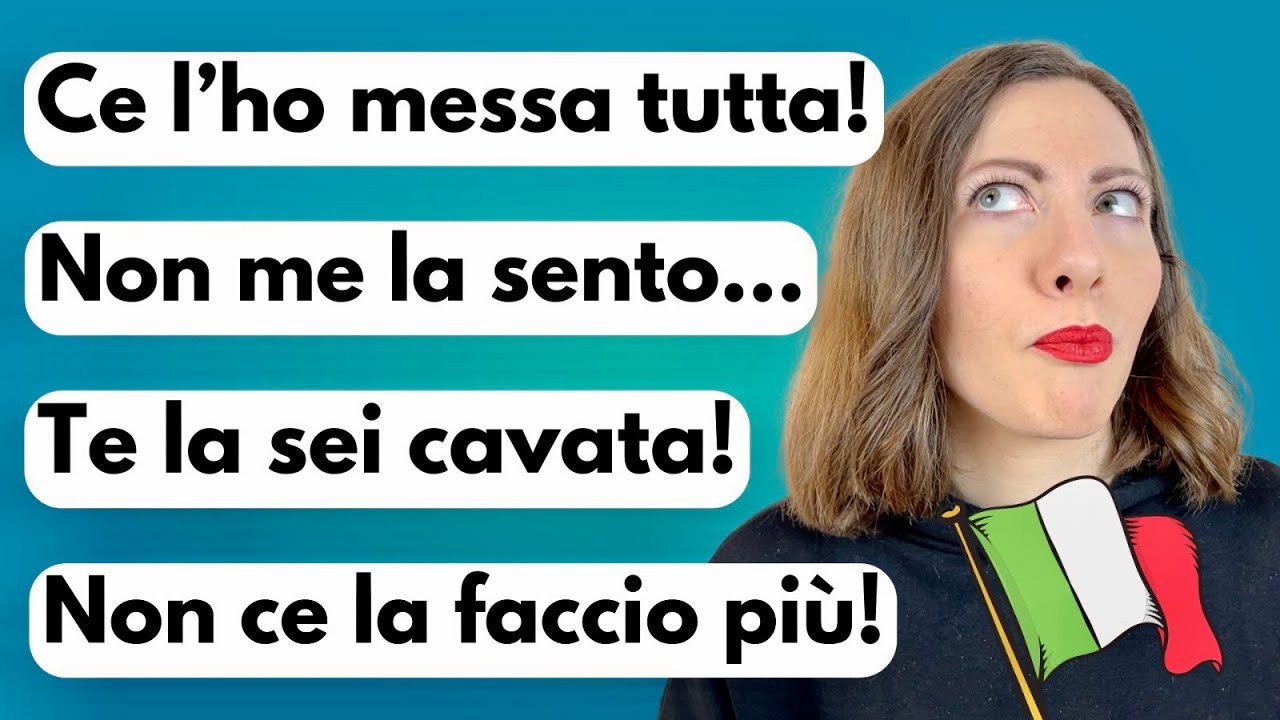
The most COMMON Italian Expressions with Pronoun Verbs
Non ce la faccio più!
The pronoun verb in this expression is farcela, formed by the verb fare and the pronouns ci (which becomes ce if followed by another pronoun) and la.
Farcela means “to succeed in something”. The expression non ce la faccio più means, instead, “to be completely exhausted, too tired to keep doing or enduring something” (such as a situation or some issues).
For example:
Abbassa il volume della musica: non ce la faccio più! Sto cercando di lavorare!
(Turn the music down: I can’t take it anymore! I’m trying to work!).
Te la sei cavata!
The pronoun verb here is cavarsela, composed by the verb cavare and the pronouns si (which becomes se) and la.
Cavarsela means “to be able to get out of particularly difficult or problematic situations with luck or with one’s own skills”.
The expression Te la sei cavata entails that “you have succeeded in your intent because of your shrewdness; you have achieved the goal, though without excelling”.
For example:
Pur avendo preparato l’esame in pochi giorni, te la sei cavata piuttosto bene (that is, you have studied less than you should have, but still you knew how to answer the questions / you got a good grade and so on).
(Although having prepared the exam in just a few days, you handled yourself pretty well).
La stai prendendo troppo alla larga / alla lontana
The pronoun verb present here is prenderla, which is formed by the verb prendere and the pronoun la.
In this case, in order to obtain an idiomatic expression, it is necessary to add to the verb either “alla lontana” or “alla larga”, giving to the expression the meaning of “saying many useless things before getting to the main contents”.
For example:
La stai prendendo troppo alla larga. Non mi importano i dettagli: voglio solo sapere perché hai litigato con lui!
(You’re taking it too far. I don’t care about the details: I just want to know why you argued with him!)
Ce l’ho messa tutta!
The pronoun verb present in this expression is mettercela, composed by the verb mettere and by the pronouns ci (ce) and la.
The expression “mettercela tutta” implies “to commit to the maximum of your potential” and it is usually used when the results achieved are not those hoped for.
For example:
Ce l’ho messa tutta, ma sono arrivata al terzo posto nella gara di atletica.
(I tried my best, but I finished third in the athletics competition).
Me la lego al dito!
The pronoun verb here is legarsela, which is composed by the verb legare and the pronouns si (se) and la.
The expression “legarsela al dito” is a very particular one and means “not to forget easily a wrong / not to forgive it”.
Its birth is ancient. It refers, in fact, to a tradition, according to which small strips of parchment, containing religious precepts, were tied to the hand, as to make sure not to forget them.
For example:
Questa volta hai esagerato: me la lego al dito! Non recupereremo mai il rapporto che avevamo prima.
(This time you have crossed the line: I will hold a grudge! We will never get back the relationship we had before).
Te la stai spassando!
The pronoun verb in this expression is spassarsela, made up of the verb spassare (not very common, with the meaning of amusing) and the pronouns si (se) and la.
“Spassarsela” has the meaning of “spending your time happily” or even “leading a good life”, full of fun and without any responsibilities.
For example:
Da quando sono iniziate le vacanze estive te la stai spassando, ho visto che sei andato prima a New York e poi a Londra.
(Ever since the summer vacations started, you have been having a really great time, I have seen that you went first to New York and then to London).
Ci sono rimasto male / Me la sono presa
The pronoun verb present in this expression is rimanerci, consisting of the verb rimanere and the pronoun ci. The other one, instead, is “prendersela”.
The first one means “to be sad”, whereas the second one means “to take offense” to something that we have been told or done.
For example:
Quando ho scoperto che le mie migliori amiche non mi hanno invitata a trascorrere il pomeriggio insieme a loro, ci sono rimasta molto male.
(When I found out that my best friends didn’t invite me to spend the afternoon with them, it hurt my feelings).
Non me la sento
The pronoun verb here is sentirsela, made up of the verb sentire and the pronouns si (se) and la.
It has the meaning of “having the courage or the energy to face something difficult and problematic”. Non me la sento denotes that we do not have this courage or such an energy.
For example:
Ieri ho fatto un duro allenamento in palestra, perciò oggi non me la sento di venire con voi a fare l’escursione.
(Yesterday I had a hard workout at the gym, so I don’t feel like going hiking with you guys today).
Non me lo sarei mai aspettato
The pronoun verb in this expression is aspettarsi, composed of the verb aspettare and the pronouns si.
It implies “to foresee something”.
For example:
Hai parlato alle mie spalle, da te non me lo sarei mai aspettato. Ci conosciamo da quando eravamo piccoli.
(You spoke behind my back, I never expected that out of you. I have known you since we were kids).
Alright, this were all the most common expressions with pronoun verbs. If you want to read up on the subject, I highly recommend you take a look at the article on pronoun verbs and I encourage you to take the test on Italian conjunctions as well!
Want the lesson PDF with exercises and solutions?
Join the LearnAmo AcademyCaricamento quiz in corso…
Podcast: Play in new window | Download (Duration: 13:28 — 15.8MB)
Iscriviti: Apple Podcasts | Spotify | Android | iHeartRadio | Podcast Index | TuneIn | Deezer | RSS | Altri...