


How do people speak in the different Italian regions? That’s this lesson’s topic! According to the Italian region in which you are, you could hear some odd expressions you have never heard before. It’s normal as each region has its own idioms that are more used in that area, but known all over Italy. These expressions are fascinating because they are influenced by the local dialects or the history and the culture of the different regions. Let’s see the most famous and common ones!
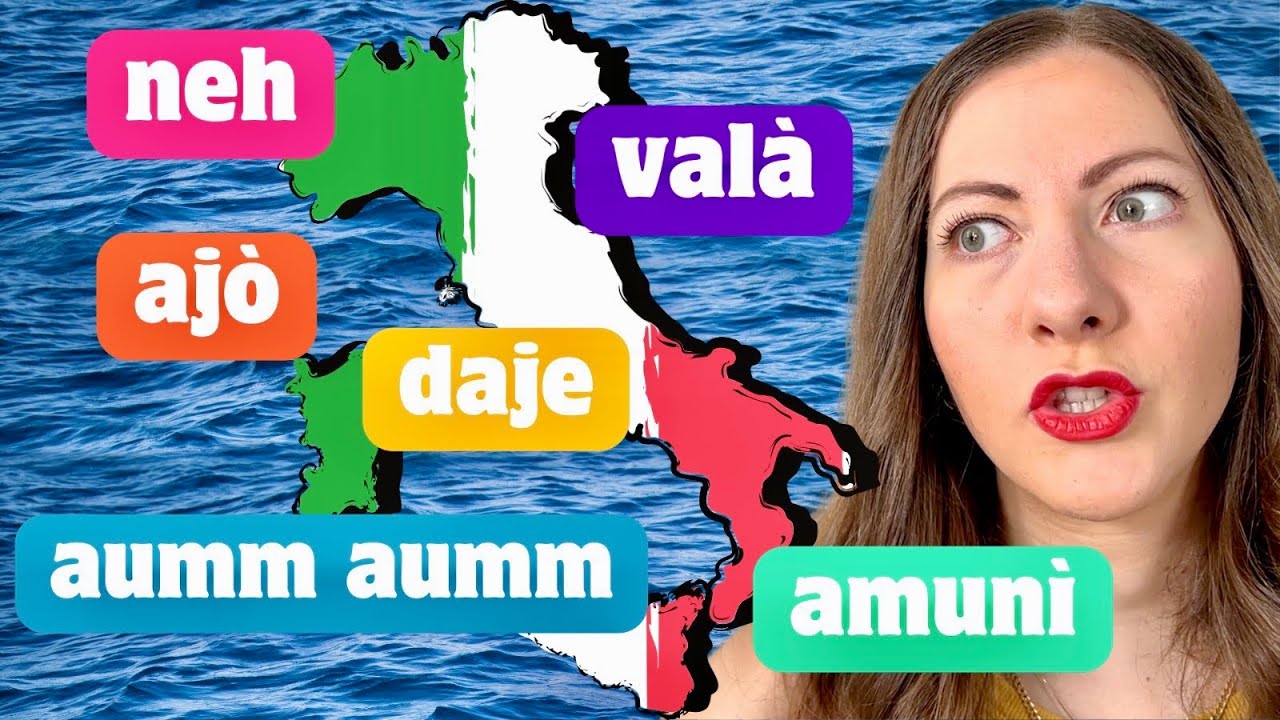
The most famous REGIONAL EXPRESSIONS in Italy
1. LAZIO
“Daje“
Is nothing other than the Roman version of the Italian exclamation “Dai”, but it has more uses and meanings than this!
Nowadays it’s conquering Italy…and the world! At first foreigners don’t understand it, but then they envy us for it!
Why so? Because, as I said before, it fits everywhere, like parsley:
- It can rush people (Daje! S’è fatta ‘na certa!)
- It can express consent and give confirmation (Mangiamo pollo stasera? Daje.)
- It can encourage people (Daje! Vai e spacca tutto!)
- It can express that something has finished (Daje. Ce l’abbiamo fatta a finire il progetto. Adesso possiamo riposarci)
- It can express joy and happiness (Daje! La Roma ha vinto ancora!)
- It can express surprise or discomfort (Daje! Che figo il tuo nuovo appartamento! / Daje! Non impari mai tu! Hai sbagliato ancora!)
- Especially among young people it’s used as a way of greeting (Daje, zio! Se beccamo!)
“Cercà Maria pe’ Roma“
Look at the abbreviations in the expression, they are typical of the dialect.
This way of saying is used when the search for something or someone is really difficult, almost impossible.
It’s a synonym of the Italian expression “Cercare un ago in un pagliaio”.
2. TUSCANY
“Mi garba parecchio” / “Non mi garba per nulla”
The verb “garbare” is typical of Tuscany and it’s used simply as an equivalent of the Italian verb “piacere”, both for people and things.
Here’s a little fun fact: Do you know why they say it?
It comes from the name of an ancient florentine street: via del Garbo (today known as via Condotta). This was a street with many artisan shops that produced the most elegant and valuable woolen cloths, appreciated and sold all over Europe.
The artisans used a fine wool coming from the Arabian Sultanate of Garb (North Africa) and the street took it’s name.
3. EMILIA ROMAGNA
Valà! / Ma va là!
It’s a typical expression from Romagna, but popular all over northern Italy. It’s very difficult to find an equivalent in other languages, as it has plenty of meanings:
- It can be used as “figurati!” to those who thank, as to say “don’t worry about it at all” (Valà! Non è niente, non preoccuparti!)
- It can be used to express skepticism or disbelief (Ma va là! Non ci credo!)
- It can be used before doing something that you don’t want to do, but it must be done (Valà, facciamo anche questa…)
- It can be used to imply something (Valà, valà… Hai capito cosa intendo!)
Sorbole! (read “Sciorbole”)
This expression is typical of Bologna and it’s used to express amazement at something seen or heard, but it’s also used as a filler word or an intensifier in conversations.
But, where does “sorbole” come from?
Most likely it comes from the name of a fruit of the Romagna countryside (nowadays almost impossible to find) the sorb.
Perhaps precisely because it’s almost unobtainable, when you find it you are so amazed that you exclaim with joy…
Who knows…
4. CAMPANIA
“Aumm aumm”
When it’s referred to something it means “shady”, so that it must be kept as a secret as it’s not completely honest.
As a matter of fact, it’s the onomatopoeia to indicate the closing of the mouth.
It can also refer to something done to the detriment of a third person or an institution, so somewhat illegal.
However, words are not enough, you also need to gesticulate.
“Jamme bell’, jà!”
It’s a Neapolitan way of saying, very popular in the rest of Italy: it’s an exclamation of exhortation, to rush people. Yes, it’s just like “Dai!”.
“Jamme” is the imperative of the verb “andare” in the Neapolitan dialect (It would be “Let’s go”)
And “Jà” is its abbreviation.
As to say “Come on, let’s go!”.
Stop reading Italian.
Start speaking it.
Online lessons in groups of 4, organised by level and goals, with qualified teachers. Pick the day and time that suit you from the available slots.
Max 4 students:
there’s a seat for you
5. SICILY
“Amunì”
This expression was created in Palermo, but it’s known all over Sicily and outside.
Guess what…this is also an expression of exhortation (let’s go!), just as the previous Neapolitan one…we Italian are always in a hurry…in other words, it’s an encouragement to hurry up or to make a decision. There’s also the variation “Amunìnni”.
6. SARDINIA
“Eja”
It’s one of the most popular words in Sardinia and it simply means “Yes”.
“Ajò”
In Sardinian it’s used both to greet (like “Ciao”) and to encourage, just like the famous “Dai!”.
7. PUGLIA
“Attento ancora cadi”
This “ancora” is clearly different from the one of standard Italian, it’s very peculiar and has this meaning only in the Apulian dialect.
It’s used instead of the subjunctive: it means “in case of”, “if ever”.
So it’s like: “Be careful, I wouldn’t want you to fall”
“Guarda nella cassetta della posta, ancora è arrivata la sua lettera”
“Compra più vino, ancora gli ospiti vogliono bere tanto”
“Mannaggia”
The word mannaggia is actually used all over southern Italy and is becoming common in the North, but it seems that it’s more popular in Puglia and Basilicata
It comes from the Neapolitan expression mal nʼaggia ( “I wish you ill”), originally used as an insult and a curse.
However, today it has lost this strong negative meaning and it’s mostly used to express rage, disappointment or sadness.
8. LOMBARDIA
“Che sbatti!”
It derives from the longer version “Che sbattimento!”.
It’s very common among young people and it’s used when you don’t want to do something underlying the anger, the annoyance and the frustration that you feel by doing so.
9. PIEMONTE
“Neh”
It’s a grammatical particle used at the end of a sentence, like the Italian expression “vero?”.
It gives more certainty to the statement just made and in a way also demands the approval of the interlocutor.
(Oggi è proprio una bella giornata, possiamo andare a fare un’escursione, neh?)
10. LIGURIA
“Anda a fase na vasca”
This expression is equivalent to “Andare a fare due passi / fare un giro”, so to go for a walk without a particular purpose.
This expression is not surprising as in Italian there’s the expression “fare le vasche”, which means “going up and down the same place, usually an avenue”. It is especially referred to the evening stroll of young people in the main street or square of the city.
11. VENETO
“Veccio, reffite!”
It means “old man, wake up!”.
The dialectal verb “reffarsi” means “to wake up, to act in an intelligent way”
It’s very common among young people.
12. CALABRIA
“Gabbu”
It indicates the action of mocking someone, especially a weak and fool person. For example it’s used in proverbs such as Cu’ faci ‘u gabbu a l’autri, ‘u soi prestu ‘nci veni, which in standard Italian means: “Who mocks others will soon be mocked in turn”.
But don’t you think that you can only find this expression in Calabria!
No…
As a matter of fact, the standard Italian has the verb “gabbare”, which means “to cheat or to swindle”.
If you liked these regional expressions you can discover other aspects of Italian regions with the video: Interesting facts about Italian Regions.
And don’t forget to enter the contest by italki and try to win 400€ of Italian classes!
Want the lesson PDF with exercises and solutions?
Join the LearnAmo AcademyCaricamento quiz in corso…
Podcast: Play in new window | Download (Duration: 19:40 — 22.8MB)
Iscriviti: Apple Podcasts | Spotify | Android | iHeartRadio | Podcast Index | TuneIn | Deezer | RSS | Altri...