


You’ve been studying Italian for months, you know grammar by heart, you can even conjugate irregular verbs… then you arrive in Italy, you sit at a bar, you hear two guys chatting and you barely understand anything! The reason is simple: no textbook teaches you slang, those informal and living words that Italians actually use every day. Let’s discover together the 20 slang expressions to understand — and speak — like a real Italian.
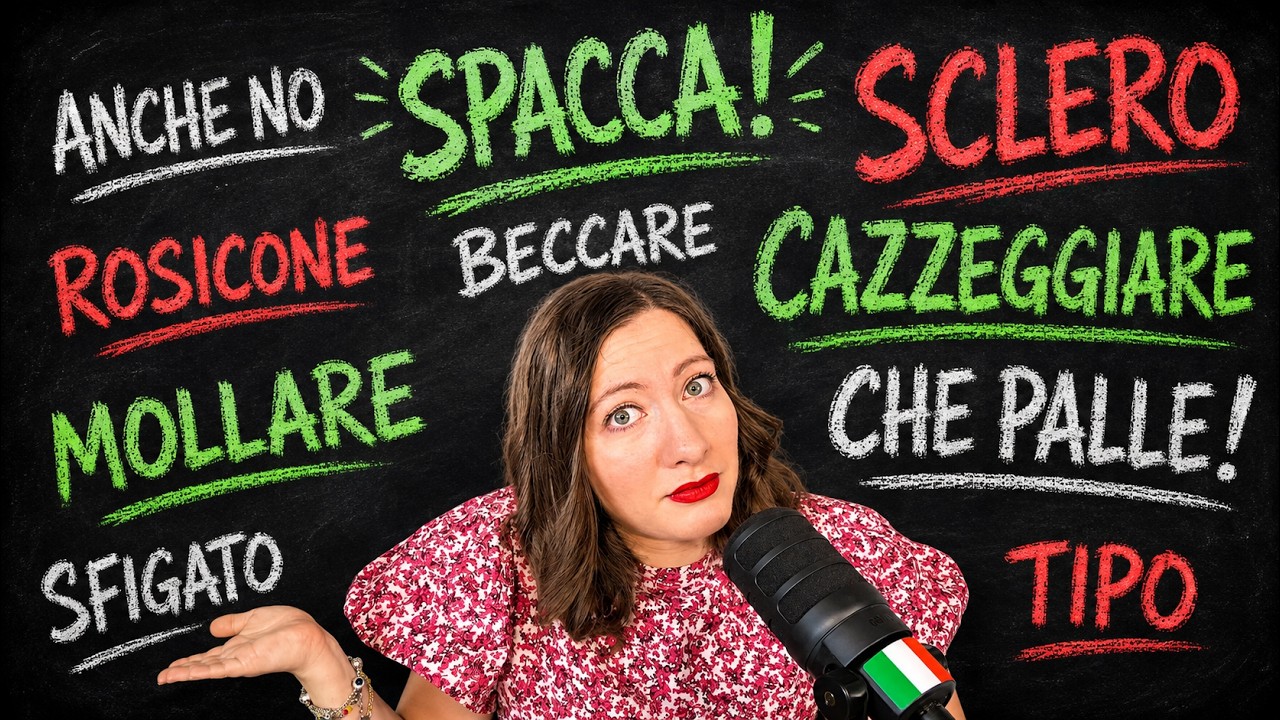
Learn These Expressions and Stop Sounding Like a Textbook
Italian slang is the key to escaping the “little grammar-book robot” and becoming truly spontaneous. The 20 words we’ll see are the ones you constantly hear in movies, TV series, songs, and everyday conversations. Let’s look at them one by one, divided into five groups.
The 5 Wildcard Words of Italian Slang
Let’s start with the “wildcard” words, the ones you hear in every sentence and that Italians use as natural fillers to speak like a native.
1. Boh
The undisputed queen of Italian slang: an interjection practically untranslatable with a single word. It means “I don’t know”, “I have no idea”, but depending on the tone it also expresses indifference, doubt, or resignation.
- “A che ora apre il museo? – Boh, prova a guardare sul sito!” [What time does the museum open? – Boh, try to check on the website!] (= I don’t know)
- “Ti è piaciuto il ristorante? – Mah, boh… niente di speciale.” [Did you like the restaurant? – Mah, boh… nothing special.] (= indifference)
- “Perché Marco è arrabbiato? – Boh! E che ne so io.” [Why is Marco angry? – Boh! How should I know.] (= resignation)
Fun fact: it’s almost always accompanied by the gesture of raised shoulders and open hands. You can also stretch it out (“booooh!”) for emphasis. Everyone uses it, from children to grandparents.
2. Tipo
Literally means “type, category”. But in slang it does two jobs: it’s a filler, like the infamous English “like”, or it means “about, more or less”, often to introduce an example.
- “Ci vediamo tipo alle otto.” [See you tipo at eight.] (= around eight)
- “Ero tipo sotto shock quando l’ho saputo!” [I was tipo in shock when I found out!]
- “Mi va qualcosa di leggero, tipo un’insalata.” [I feel like something light, tipo a salad.]
“Un tipo” or “una tipa” also generically indicates “a person”. But watch out: as a filler it’s the classic catchphrase of younger people. Use it to sound natural, but in moderation.
3. Roba
An informal word as vague as it is convenient: it means “thing, things, objects, material” (in English “stuff”). It’s perfect when you don’t want to, or don’t know how to, call something with precision.
- “Raccogli la tua roba!” [Pick up your stuff!] (= your things)
- “Ho un sacco di roba da fare prima di stasera.” [I have tons of stuff to do before tonight.]
- “Togli questa roba dal tavolo, dobbiamo mangiare.” [Take this stuff off the table, we have to eat.]
It shines in exclamations: “che roba!” [what a thing!] for amazement, “roba da matti!” [crazy stuff!] for something absurd. It has Germanic origins: it comes from a word that meant “loot”, the same one from which the verb “rubare” [to steal] also comes.
4. Un Sacco
It means “a lot, a whole lot, tons”. The image is crystal clear: a nicely full sack, that is, a large quantity. It works with verbs, with nouns, and even with adjectives.
- “Mi sei mancato un sacco!” [I missed you un sacco!]
- “C’era un sacco di gente alla festa.” [There was un sacco of people at the party.]
- “Tuo fratello è un sacco simpatico.” [Your brother is un sacco likeable.]
It’s part of a nice family of expressions meaning “a lot”, like “una marea di”, “una cifra” and “un botto”. In short, ways to exaggerate in Italian we have… un sacco!
5. Anche No
A sharp and ironic refusal: “no way”, “not a chance”, “not in your dreams”. The beauty is that we use “anche” [also], which usually serves to add something, followed by a dry “no”.
- “Una corsetta domani alle sei di mattina? – Eh, anche no, grazie!” [A little run tomorrow at six in the morning? – Eh, anche no, thanks!]
- “Lavorare anche nel weekend? Ma anche no.” [Work on weekends too? But anche no.]
- “Pagare quindici euro per un cocktail? Anche no.” [Pay fifteen euros for a cocktail? Anche no.]
It’s all about the tone: it must be said with a certain brazen calm, maybe with a raised eyebrow. It has a close relative: “anche basta!” [enough already!], used when something or someone has really worn us out.
Slang for Judging Things and People
Four words to express your judgment about someone or something, perfect for expressing enthusiasm in Italian naturally.
6. Figata
Noun: a fantastic, gorgeous, super interesting thing (in English “a cool thing”). Perfect for expressing enthusiasm towards an object, a place, or an experience.
- “Che figata questo videogioco!” [What a figata this videogame!]
- “Vivere in Giappone per un anno? Una figata pazzesca!” [Living in Japan for a year? An insane figata!]
- “Hanno aperto una pista di pattinaggio in centro: che figata!” [They opened a skating rink downtown: what a figata!]
Watch out: “figata” only describes things, never people. For people there’s “figo/figa”. On the plus side, “figata” is always polite and safe: you can use it anywhere without any embarrassment.
7. Figo / Figa
An adjective to describe people (and things) that are very cool, sharp, trendy, sometimes attractive: figo in the masculine, figa in the feminine.
- “Il tuo nuovo collega è davvero figo.” [Your new coworker is really figo.]
- “Che giacca figa!” [What a figa jacket!]
- “Sei stata fighissima a rispondergli così!” [You were fighissima for answering him like that!]
Important warning: in the feminine, “figa” is also a vulgar term for the female genital organ. Referred to a woman it can therefore be ambiguous or embarrassing, depending on the tone. The trick: for beautiful things use “figata”; to say a man is figo no problem; with the feminine, just a bit more attention.
Origin and Geographical Variants
Nothing to do with the “fico” [fig] fruit! According to the Accademia della Crusca, it probably originated as Roman youth slang from the 70s, from “ficaccio”, a popular deformation of “efficace” [effective] (attested even in a Belli sonnet from 1835!). Geographically, “figo” (with the g) is more typical of the North, while “fico” (with the c) is more typical of Central Italy (Rome, Tuscany).
8. Sfigato / Sfigata
The opposite of figo, with two related meanings: “unlucky” or “loser”. The context tells you which of the two the speaker means.
- “Marco perde sempre il treno, gli si rompe tutto: è proprio sfigato!” [Marco always misses the train, everything breaks on him: he’s really sfigato!] (= unlucky)
- “Smettila di fare lo sfigato e invitala a uscire!” [Stop being a sfigato and ask her out!]
- “Sei rimasto a casa il sabato sera? Che sfigato!” [You stayed home on Saturday night? What a sfigato!] (among friends, joking)
It comes from “sfiga”, which in slang means “bad luck”, from which also the exclamation “che sfiga!” [what bad luck!]. It’s a bit offensive: among friends and in a joking tone it’s fine, but avoid using it on a stranger.
9. Spaccare
Literally “to break in two”, but in slang it means “to be amazing, exceptional, to go big” (in English “to rock”, “to kill it”).
- “Questa canzone spacca!” [This song spacca!]
- “Hai spaccato all’esame, bravissima!” [You spaccato at the exam, great job!]
- “Il tuo nuovo taglio di capelli spacca davvero.” [Your new haircut really spacca.]
To exaggerate even more, “spaccare di brutto”. Small note: “spaccarsi” (reflexive) means instead “to work really hard”. But “spacca!” by itself is simply the highest compliment.
Stop reading Italian.
Start speaking it.
Online lessons in groups of 4, organised by level and goals, with qualified teachers. Pick the day and time that suit you from the available slots.
Max 4 students:
there’s a seat for you
Moods: Between Annoyance and Relaxation
Five slang expressions to talk about emotions, annoyances, and moments of relaxation. For other similar formulas, you can check out the guide on everyday colloquial expressions.
10. Che Palle
A great classic of annoyance: it means “how boring”, “what a hassle”, “what a pain”. Literally “palle” are testicles, so it’s a bit vulgar, but so widespread that you’ll hear it everywhere.
- “Devo rifare tutto da capo, che palle!” [I have to redo everything from scratch, che palle!]
- “Piove di nuovo e avevo organizzato il picnic… che palle.” [It’s raining again and I had organized the picnic… che palle.]
- “Domani riunione alle otto. Che due palle.” [Tomorrow meeting at eight. Che due palle.]
“Rompere le palle” means to bother, while “avere le palle piene” means to be fed up. Among friends it’s totally normal, but avoid it in formal contexts; more polite versions are “che noia”, “che barba”, “che pizza”. To go deeper, there’s a dedicated guide on bad words and vulgar expressions in Italian.
11. Sclerare
It means “to lose patience, to go nuts, to explode with anger” (in English “to freak out”).
- “Quando ho visto il conto, sono sclerato di brutto!” [When I saw the bill, I totally sclerato!]
- “Mia madre sclera se lascio la stanza in disordine.” [My mom sclera if I leave the room messy.]
- “Sto sclerando con questo computer che si blocca in continuazione!” [I’m sclerando with this computer that keeps freezing!]
It derives, jokingly, from the medical term “arteriosclerosi” (because of the mental decline the disease can cause), but in slang medicine has nothing to do with it. There’s also the noun “sclero”: “che sclero!” [what a sclero!] for a stressful situation. It’s a rather youthful word.
12. Rosicare
Literally “to gnaw, to bite in small pieces”, but in slang it means “to be eaten up by envy or anger, to not accept a defeat” (in English “to be salty”).
- “Ho preso trenta e lui rosica perché ne ha presi ventotto.” [I got a thirty and he rosica because he got a twenty-eight.]
- “Hai perso e basta, dai, non rosicare!” [You lost and that’s it, come on, don’t rosicare!]
- “Quando ha vinto la mia squadra, gli avversari rosicavano di brutto.” [When my team won, the opponents rosicavano a lot.]
Someone who always rosica is a “rosicone”. It originated in Roman dialect, but now all of Italy uses it. It’s related to the expression “rodersi il fegato” [to gnaw at one’s liver]: the image is that of envy gnawing at you from the inside.
13. Scialla
It means “chill, stay calm, relax, no problem”. A small invitation to calm, perfect for defusing drama.
- “Scialla, abbiamo ancora un sacco di tempo!” [Scialla, we still have un sacco of time!]
- “Hai sbagliato l’esame? Scialla, lo rifarai!” [You failed the exam? Scialla, you’ll retake it!]
- “Sono in ansia per il colloquio! – Ma scialla, sei preparatissimo.” [I’m anxious about the interview! – But scialla, you’re super prepared.]
Experts disagree on the origin. Some trace it to the Arabic “inshallah” (“if God wills”), perhaps arrived through Ligurian dialects and Romanesco, others to the Italian verb “scialare” (to enjoy oneself), from the Latin “exhalare”. In any case, it exploded throughout Italy in 2011 thanks to Francesco Bruni’s film Scialla!.
14. Daje
Roman version of “dai”, reinforced: “come on!”, “let’s go!”, “that’s how it’s done!”. A cry of encouragement and enthusiasm. To discover other Italian regional expressions, there’s a dedicated guide.
- “Daje, ce la puoi fare!” [Daje, you can do it!]
- “Pizza stasera? – Daje!” [Pizza tonight? – Daje!]
- “Daje Roma, daje!” [Daje Roma, daje!] (at the stadium)
It’s pronounced “dàie”, with the “j” read as a long “i”, never the English way! It’s the anthem of Roman identity, closely tied to A.S. Roma and champions like Totti, and thanks to the internet pretty much all Italians use it now.
Slang Verbs for Everyday Life
Four verbs you hear every day and that help you speak with the spontaneity of native speaker expressions.
15. Beccarsi / Beccare
Literally what birds do with their beak. In slang it has three lives: to meet up, to catch someone in the act, or to get and receive something (usually unwelcome).
- “Ci becchiamo alle nove davanti al cinema?” [Shall we becchiamo at nine in front of the cinema?] (= meet up)
- “L’hanno beccato a copiare.” [They beccato him copying.] (= caught in the act)
- “Ho beccato un raffreddore; se parcheggi lì becchi una multa.” [I beccato a cold; if you park there you becchi a fine.] (= got)
It’s one of those super useful jolly verbs for a thousand situations, from a meet-up with friends to a fine you happened to catch. A thousand uses, just one beak!
16. Sgamare
It means “to discover something hidden, to figure out a trick, to catch someone in the act” (in English “to bust someone”).
- “Volevo farti una sorpresa, ma mi hai sgamato subito!” [I wanted to surprise you, but you sgamato me right away!]
- “Ho sgamato il suo piano: voleva fregarmi.” [I sgamato his plan: he wanted to cheat me.]
- “Non puoi mentirmi, ti sgamo a un chilometro!” [You can’t lie to me, I sgamo you a mile away!]
Compared to “beccare”, it stresses the idea of intuiting and seeing beyond deception. As an adjective, a “sgamata” person is clever, sharp, savvy, and doesn’t get fooled by anyone.
17. Cazzeggiare
Warning: it comes from a swear word, so it’s a bit vulgar. It means “to waste time pleasantly, to loaf around, to joke” (in English “to goof off”).
- “Oggi non ho fatto nulla, ho solo cazzeggiato sul divano.” [I didn’t do anything today, I just cazzeggiato on the couch.]
- “Ragazzi, smettetela di cazzeggiare e studiate!” [Guys, stop cazzeggiare and study!]
- “Ci siamo visti, ma niente di che: abbiamo cazzeggiato un paio d’ore.” [We saw each other, but nothing special: we cazzeggiato a couple of hours.]
There’s also the noun “cazzeggio”, as in “una serata di puro cazzeggio” [an evening of pure cazzeggio]. Among friends no problem, but avoid it in formal contexts. A more polite synonym is “oziare” [to laze around], which however is much less funny.
18. Mollare
Literally “to let go, to loosen”: it comes from “molle” [soft], from which also the famous nautical use (“mollare gli ormeggi” [to cast off the moorings]). In slang it means to dump your partner, or to give up.
- “Mi ha mollato dopo tre anni.” [He mollato me after three years.] (= dumped)
- “Perché hai mollato proprio adesso?” [Why did you mollato right now?] (= gave up)
- “Ho mollato la palestra dopo due settimane.” [I mollato the gym after two weeks.]
“Molla!” means “leave me alone”, while “mollare la presa” means to let go, to stop insisting or worrying. And the most famous phrase of all: “mai mollare!” [never give up!].
The Slang of the Younger Generation
To finish, two expressions much loved by Gen Z, full of English influences, similar to other anglicisms and gallicisms in Italian.
19. Cringe (Cringiare)
An anglicism much loved by Gen Z: it indicates an embarrassment so strong it gives you chills, often felt for someone else. It’s the famous “second-hand embarrassment”.
- “Quel video è troppo cringe!” [That video is so cringe!]
- “Mi fa cringe quando i miei genitori ballano alle feste.” [It makes me cringe when my parents dance at parties.]
- “Ha provato a fare il simpatico, ma è stato solo cringe.” [He tried to be funny, but it was just cringe.]
It’s been Italianized into the verb “cringiare”. It’s part of a wave of youth anglicisms turned into verbs: “flexare” (to brag), “ghostare” (to suddenly disappear), “shippare” (to root for two people to get together).
20. Fra / Zio / Bro
Friendly nicknames among young people, like “bro” or “man” in English: “fra” (from “fratello” [brother]), “zio” (yes, “uncle”, but it has nothing to do with family!) and “bro” (from English “brother”).
- “Tutto bene, fra?” [Everything good, fra?]
- “Zio, non ci crederai mai!” [Zio, you’ll never believe it!]
- “Daje zio, muoviamoci che facciamo tardi!” [Daje zio, let’s move or we’ll be late!]
The family is large: there are also “raga” (from “ragazzi” [guys]) and “bella” (as a greeting). But they’re all super informal and only among friends: never call your professor or your boss “zio”… it would be way too cringe!
Summary Table of the 20 Italian Slang Words
Here’s a table summarizing the 20 Italian slang words with their main meaning.
| Slang | Meaning |
|---|---|
| Boh | I don’t know / no idea |
| Tipo | About / filler (like “like”) |
| Roba | Things, objects, stuff |
| Un sacco | A lot, tons |
| Anche no | Sharp and ironic refusal |
| Figata | A fantastic thing |
| Figo / Figa | Cool, attractive person |
| Sfigato | Unlucky / loser |
| Spaccare | To be exceptional |
| Che palle | How boring, what a hassle |
| Sclerare | To lose patience, to freak out |
| Rosicare | To be eaten up by envy |
| Scialla | Chill, relax |
| Daje | Come on! Let’s go! (Roman) |
| Beccarsi | To meet up / to catch in the act |
| Sgamare | To figure out, to bust |
| Cazzeggiare | To waste time pleasantly |
| Mollare | To dump partner / to give up |
| Cringe | Chills-inducing embarrassment |
| Fra / Zio / Bro | Friendly nicknames among young people |
Frequently Asked Questions
Can Slang Be Used in Formal Contexts?
It depends on the slang. Words like boh, tipo, roba and un sacco are acceptable even in informal conversations with strangers. But che palle, cazzeggiare, figa and zio should be used only among friends. Never in professional contexts.
What’s the Difference Between “Figata” and “Figo”?
Figata is a noun and only describes things (“che figata questo libro!” [what a figata this book!]). Figo/figa is an adjective and describes both things and people (“è una persona figa” [she’s a figa person]). Watch out that “figa” in the feminine can be ambiguous.
Where Does the Word “Scialla” Come From?
Experts disagree. One theory traces it to the Arabic “inshallah” (“if God wills”), another to the Italian verb “scialare” (to enjoy oneself), from the Latin exhalare. It became famous throughout Italy in 2011 thanks to Francesco Bruni’s film Scialla!.
How Is “Daje” Pronounced?
It’s pronounced “dàie”, with the “j” read as a long “i”, never the English way. It’s a Roman reinforced version of “dai”.
What Does “Cringiare” Mean?
Cringiare is the Italianization of the English cringe and means to feel an embarrassment so strong it gives you chills, often for someone else’s behavior. It’s part of the youth anglicisms like flexare, ghostare, shippare.
Do you want to take Italian lessons with our qualified native teachers? Purchase your Italiano Intensivo package!
Want the lesson PDF with exercises and solutions?
Join the LearnAmo AcademyLoading quiz…
Podcast: Play in new window | Download (Duration: 35:51 — 18.2MB)
Iscriviti: Apple Podcasts | Spotify | Android | iHeartRadio | Podcast Index | TuneIn | Deezer | RSS | Altri...