

'/%3E%3Cpath%20fill='%23b2b2b2'%20d='M241%20382q0%2016%2017%2026%2017%2011%2042%2011t42-11q16-11%2017-26V269H241'/%3E%3Cpath%20fill='%239f7e00'%20d='M241%20379q0%2014%208%2023%209%209%2021%209%2014%200%2021-9%209-9%209-23V269h-59'/%3E%3Cpath%20d='M241%20339v-70h59v110q0%2014-9%2023l-6%205v-68h-15v72q-8%200-14-4v-68zm59%2040c0%2022%2015%2032%2029%2032%2021%200%2030-18%2030-32v-40h-59'/%3E%3Cpath%20fill='%239f7e00'%20d='M266%20277v5h2v12h-3v-5h2v-5h-9v5h2v5h-4v9h3v18h-5v10h34v-10h-5v-18h3v-9h-4v-5h2v-5h-9v5h2v5h-3v-12h2v-5zm42%20101q0%2010%206%2017%206%206%2015%207%2010-1%2016-7%206-7%206-17v-29h-43'/%3E%3Ccircle%20fill='%230044ad'%20cx='329.5'%20cy='372'%20r='6'/%3E%3Cellipse%20fill='%230044ad'%20cx='300'%20cy='340'%20rx='16'%20ry='21'/%3E%3C/svg%3E)
Have you ever heard an Italian say “ci sta”, “ci tengo” or “ci penso io” and not understood what it means? You know all the verbs… but the problem is that little particle that changes everything: the “ci”. In this article you’ll discover 6 pronominal verbs with “ci” that Italians use every day and that will make your Italian sound much more natural.
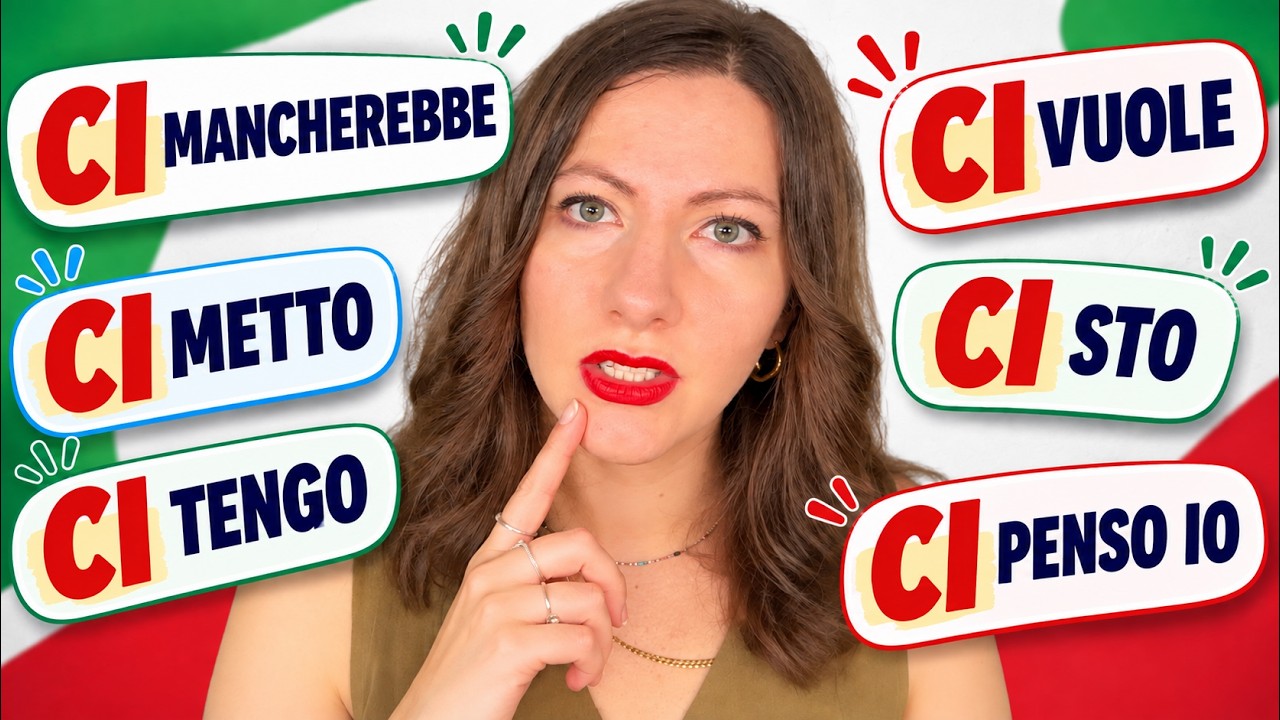
6 Constructions with CI to Sound Natural
Pronominal verbs with the particle “ci” are a fundamental feature of colloquial Italian. They often don’t have a direct equivalent in other languages, but they’re used constantly in everyday conversations. If you want to dive deeper first into the basic function of the CI particle in Italian, you can consult the dedicated guide.
Tenerci [To Care About Something]: When Something Is Important to You
The verb tenere, on its own, means to hold something in your hands or in a certain position. For example: “Tengo il libro sul tavolo” [I’m holding the book on the table]. But when we add the “ci”, the meaning changes completely.
Meaning and Use of Tenerci [To Care About Something]
Here are some practical examples:
- “Ci tengo moltissimo alla nostra amicizia, sei una persona speciale per me.” [I really care about our friendship, you are a special person to me.]
- “Ci tengo a dirti che ho apprezzato tantissimo il tuo regalo.” [I really want to tell you that I appreciated your gift so much.]
- “Marco ci tiene alla sua macchina come se fosse un figlio!” [Marco cares about his car as if it were a son!]
Tenerci means that something or someone is very important to us, we hold it close to our hearts. If you say “ci tengo alla nostra amicizia” [I care about our friendship], you’re saying that our friendship has great value to you.
Attention to the Preposition
Tenerci always uses the preposition “a”, both before a noun and before a verb in the infinitive.
| Structure | Example |
|---|---|
| Tenerci + a + pronoun | Ci tengo a te [I care about you] |
| Tenerci + a + verb | Ci tengo a spiegarti [I really want to explain to you] |
| Tenerci + alla/al + noun | Ci tengo alla verità [I care about the truth] |
Cultural note: in Italy, when someone tells you “ci tengo a te” [I care about you], it’s a strong affective statement. It’s not romantic like “ti amo” [I love you], but it indicates a deep bond. If an Italian friend tells you this, you’re truly important to them.
Starci [To Be Up For It / To Make Sense]: the Colloquial Expression Par Excellence
Ci sta is a super colloquial expression that you’ll hear everywhere, especially among young people. It has become so widespread that it’s part of the most used everyday colloquial Italian expressions.
First Use: Accepting a Proposal
Examples:
- “Andiamo a prendere un gelato? Ci sta, anche perché fa caldissimo oggi!” [Shall we go get an ice cream? Sounds good, also because it’s super hot today!]
- “Ti va di studiare insieme domani? Sì, ci sta assolutamente!” [Do you feel like studying together tomorrow? Yes, absolutely!]
- “Mi prendo un altro caffè, ci sta?” [I’ll have another coffee, is it ok?]
In these cases, “ci sta” means “it’s fine”, “I agree”, “it’s a good idea”. It’s an informal way to accept a proposal.
Second Use: Describing an Attractive Person
Example:
- “Quella ragazza ci sta un sacco!” [That girl is really hot!]
In this case it means that person is very pretty, attractive. It’s a slang expression used by young people, so you should use it only in very informal contexts, among friends. It should be avoided in professional settings.
Third Use: Indicating that Something Is Understandable
Example:
- “Sei stanco dopo una giornata così lunga? Ci sta!” [Are you tired after such a long day? It makes sense!]
Here “ci sta” means “it’s understandable, it’s normal”. It’s a way to validate a situation or feeling as reasonable.
Volerci [To Take / To Be Needed] vs Metterci [To Take Time]: the Difference that Makes the Difference
Two verbs that many students confuse: volerci and metterci. They look like twins, but they aren’t. For a complete analysis, you can read the guide on ci vuole vs ci mette.
Volerci [To Be Needed]: General Necessity
Examples:
- “Ci vuole molta dedizione per diventare un bravo musicista.” [It takes a lot of dedication to become a good musician.]
- “Ci vogliono circa tre giorni per ricevere il pacco.” [It takes about three days to receive the package.]
- “Ci vuole un pizzico di sale in questa ricetta.” [A pinch of salt is needed in this recipe.]
Volerci is used to say what is needed in general to do something: time, ingredients, qualities, money. It’s a verbo impersonale, therefore it doesn’t have a precise subject. For this reason it’s used only in the terza persona singolare o plurale, depending on the object.
| Object | Form | Example |
|---|---|---|
| Singular | Ci vuole | Ci vuole pazienza [It takes patience] |
| Plural | Ci vogliono | Ci vogliono tre giorni [It takes three days] |
Metterci [To Take Time]: Personal Time
Examples:
- “Io ci metto venti minuti per andare in palestra.” [I take twenty minutes to go to the gym.]
- “Tu quanto ci metti ad arrivare in centro?” [How long do you take to get to the city center?]
- “Mia nonna ci mette due ore per preparare il ragù, ma è il più buono del mondo!” [My grandmother takes two hours to prepare the ragù, but it’s the best in the world!]
The fundamental difference is that metterci is personale: it indicates how much time a specific person needs to do something. Therefore it changes based on the subject.
| Subject | Form |
|---|---|
| Io | Ci metto |
| Tu | Ci metti |
| Lui / Lei | Ci mette |
| Noi | Ci mettiamo |
| Voi | Ci mettete |
| Loro | Ci mettono |
Summary of the Difference
If you want to talk about a general necessity, use volerci. If you want to say how much time you take (or another specific person) to do something, use metterci.
| Phrase | Meaning |
|---|---|
| Ci vogliono due ore per arrivare a Napoli [It takes two hours to get to Naples] | In general, for anyone |
| Io ci metto due ore per arrivare a Napoli [I take two hours to get to Naples] | Specifically me |
Stop reading Italian.
Start speaking it.
Online lessons in groups of 4, organised by level and goals, with qualified teachers. Pick the day and time that suit you from the available slots.
Max 4 students:
there’s a seat for you
Mancarci [Don’t Mention It / It Would Be the Least]: Italian-Style Courtesy
The expression ci mancherebbe (or “ci mancherebbe altro”) is one of those phrases that characterize native Italian. For other expressions of native Italian speakers, there’s a dedicated guide.
The Verb Mancare [To Miss / To Be Missing] in Pronominal Form
The verb mancare, normally, means that something is absent or that you miss someone. For example: “Mi manchi tantissimo” [I miss you so much], “Manca lo zucchero nel caffè” [The sugar is missing in the coffee].
But “ci mancherebbe” is something completely different. Let’s look at the examples:
- “Posso prendere in prestito il tuo ombrello? Certo, ci mancherebbe!” [Can I borrow your umbrella? Of course, don’t mention it!]
- “Scusami per il disturbo… Ma figurati, ci mancherebbe altro!” [Sorry for the trouble… Come on, don’t mention it!]
- “Vuoi che ti accompagni a casa? No grazie, davvero, ci mancherebbe che ti scomodi a quest’ora!” [Do you want me to walk you home? No thanks, really, I wouldn’t want you to go to the trouble at this hour!]
The Two Main Uses
Ci mancherebbe is an expression of courtesy and has two main uses:
- To grant something willingly: in the first example, you’re saying “of course you can take my umbrella, it’s the least I can do for you”.
- To kindly refuse someone doing something for us: in the third example, you’re saying “no, I absolutely don’t want you to go to the trouble, it would be wrong”.
Cultural note: Italians use “ci mancherebbe” so often that it’s practically an automatic reflex. When someone thanks too much or apologizes too much, the response is almost always “ma figurati, ci mancherebbe!” [come on, don’t mention it!]. It’s a very Italian way to show kindness and availability.
Pensarci [To Think About It / To Handle It]: Watch Out for the Trap
The last verb is pensarci, and here there’s a small trap. A grammatical nuance that completely changes the meaning. To dive deeper into other pronominal verbs in Italian, you can check out the complete guide.
Two Different Meanings
Compare these two examples:
- “Non preoccuparti per la cena di stasera, ci penso io!” [Don’t worry about dinner tonight, I’ll take care of it!]
- “Vuoi venire al concerto con noi sabato? Mmm… ci penso e ti faccio sapere.” [Do you want to come to the concert with us on Saturday? Hmm… I’ll think about it and let you know.]
In the first case it’s said “ci penso io”, in the second only “ci penso”. And the meaning is completely different.
Ci Penso Io [I’ll Take Care of It]: Handling Something
In the first example, “ci penso io” means “I’ll take care of it, I’ll do it”. You’re telling the other person not to worry about dinner, because you’ll be the one taking care of it: you’ll buy the food, you’ll cook, you’ll set the table.
Ci Penso [I’ll Think About It]: Reflecting on a Decision
In the second example, “ci penso” means “I’ll think about it, I’ll evaluate the decision”. You need to think about it, you need to decide whether to go to the concert or not.
How to Distinguish the Two Uses
The rule is very simple:
| Construction | Meaning | Example |
|---|---|---|
| With personal pronoun | I’ll handle it | Ci penso io, ci pensi tu, ci pensa lei |
| Without pronoun | I’ll reflect on something | Ci penso e ti faccio sapere [I’ll think about it and let you know] |
When you add the personal pronoun at the end (io, tu, lui, lei), it means “I’ll handle it”. When there’s no pronoun, it means “I’ll reflect on something”.
Summary Table of the Verbs with CI
Here’s a table that summarizes all the pronominal verbs with “ci” seen so far, with their main meaning and a practical example. For other similar expressions, you can read the guide on expressions with CI in Italian.
| Verb | Meaning | Example |
|---|---|---|
| Tenerci | To give importance, value | Ci tengo alla nostra amicizia [I care about our friendship] |
| Starci (1) | To agree | Andiamo al cinema? Ci sta! [Shall we go to the cinema? Sounds good!] |
| Starci (2) | To be attractive (slang) | Quella ragazza ci sta un sacco [That girl is really hot] |
| Starci (3) | To be understandable | Sei stanco? Ci sta! [Are you tired? It makes sense!] |
| Volerci | To be needed (impersonal) | Ci vuole pazienza [It takes patience] |
| Metterci | To take time (personal) | Io ci metto due ore [I take two hours] |
| Mancarci | Courtesy, granting/refusing | Posso prenderlo? Ci mancherebbe! [Can I take it? Don’t mention it!] |
| Pensarci (with pronoun) | To handle something | Non preoccuparti, ci penso io [Don’t worry, I’ll take care of it] |
| Pensarci (without pronoun) | To reflect | Ci penso e ti faccio sapere [I’ll think about it and let you know] |
Frequently Asked Questions
What Are Pronominal Verbs in Italian?
Verbi pronominali are verbs that combine their basic meaning with one or more pronominal particles (like ci, ne, la, le) that change or specify the original meaning. Examples: tenerci, starci, farcela, andarsene.
What’s the Difference Between “Ci Vuole” and “Ci Metto”?
Ci vuole is impersonal and indicates a general necessity (“ci vogliono due ore” = in general, for anyone). Ci metto is personal and is conjugated according to the subject (“io ci metto due ore” = specifically me).
Can You Use “Ci Sta” in Formal Contexts?
No. “Ci sta” is a very colloquial expression, especially when it means “it’s fine” or refers to an attractive person. In formal contexts (work, official communications) it’s better to use alternatives such as “sono d’accordo” [I agree], “va bene” [it’s fine] or “è una buona idea” [it’s a good idea].
Does “Ci Mancherebbe” Always Mean the Same Thing?
It always has a value of courtesy, but with two nuances: it can serve to grant something willingly (“posso entrare? ci mancherebbe!” [can I come in? don’t mention it!]) or to kindly refuse that someone goes to trouble for us (“ci mancherebbe che tu venga apposta!” [I wouldn’t want you to come on purpose!]).
Why Are So Many Verbs with “Ci” Used in Italian?
The particle “ci” in Italian is very versatile: it can replace complements of place, indirect complements, or form pronominal verbs with their own meaning. Italians use it constantly because it makes speech more concise, expressive, and natural.
Do pronominal verbs trip you up and fill you with doubts? Turn confusion into confidence with our exclusive course: “Da «Non ce la faccio più» a «Ora me la cavo»: i verbi pronominali in 30 giorni.” With fun, bite-size lessons and targeted practice, you’ll learn to use them naturally in just one month.
Want the lesson PDF with exercises and solutions?
Join the LearnAmo AcademyLoading quiz…
Podcast: Play in new window | Download (Duration: 24:03 — 11.9MB)
Iscriviti: Apple Podcasts | Spotify | Android | iHeartRadio | Podcast Index | TuneIn | Deezer | RSS | Altri...