


Knowing and using Italian verb moods and tenses correctly is essential for clear and effective communication.
In this article, we will explore the Italian verb moods and tenses and how to use them properly.
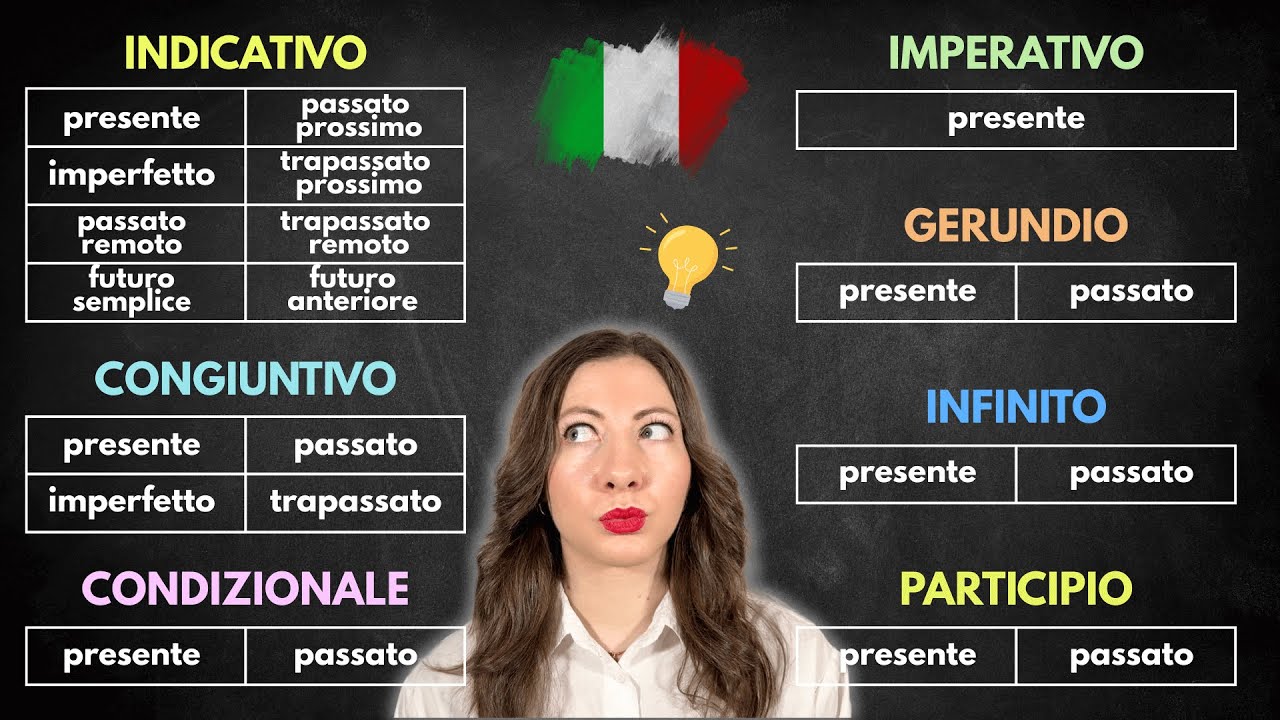
Discover How and When to Use Italian Verb Tenses
THE INDICATIVE MOOD (IL MODO INDICATIVO)
The indicative mood has 8 verb tenses.
1. PRESENT TENSE (PRESENTE INDICATIVO)
It is used to express:
Actions happening at the moment or during the period of speaking:
Examples:
Oggi mangio la pasta. [Today I eat pasta.]
Adesso parlo con un’amica. [Right now, I am talking to a friend.]
Habitual actions that repeat over time:
Examples:
Ogni mattina bevo un caffè. [Every morning I drink a coffee.]
Lucia lavora in ufficio dal lunedì al venerdì. [Lucia works in the office from Monday to Friday.]
General truths or facts:
Examples:
Il sole sorge a est. [The sun rises in the East.]
L’acqua bolle a 100°. [Water boils at 100°C.]
Planned or imminent future actions (informal):
Examples:
Domani parto per Roma. [Tomorrow, I leave for Rome.]
La prossima settimana vado dal dentista. [Next week, I’m going to the dentist.]
Ceniamo insieme venerdì prossimo? [Shall we have dinner together next Friday?]
Actions that started in the past and are still ongoing, using the VERB IN PRESENT + DA + time period:
Examples:
Vivo a Firenze da tre anni. [I have been living in Florence for three years.]
Lavora in questo ufficio da due mesi. [He/she has been working in this office for two months.]
Historical present:
Examples:
Michelangelo Buonarroti nasce il 6 marzo 1475 in provincia di Arezzo. [Michelangelo Buonarroti is born on March 6, 1475, in the province of Arezzo.]
How is the Italian present tense formed?
2. PRESENT PERFECT (PASSATO PROSSIMO)
It is used to express:
A past action that has consequences in the present:
Examples:
Mi sono trasferita in questa casa due mesi fa. [I moved into this house two months ago.]
Roberto si è laureato in Ingegneria. [Roberto graduated in Engineering.]
Actions that took place and were completed in a specific period of time in the past:
Example:
Ho vissuto a Roma per due anni. [I lived in Rome for two years.]
Note:
Nowadays, the present perfect is used instead of the past remote, which is now almost only used in some Italian regions, in spoken language, or in literature. Therefore, we also use the present perfect to express:
Actions that happened and ended once (or a specific number of times) at a precise moment in the past:
Examples:
Da bambina, ho incontrato il Presidente tre volte. [As a child, I met the President three times.]
Ieri sono andata al cinema. [Yesterday I went to the cinema.]
Ho preso l’aereo per la prima volta a 3 anni. [I took the plane for the first time when I was 3 years old.]
Ho preso l’aereo 10 volte in tutta la mia vita. [I have taken the plane 10 times in my life.]
Did you understand how to use the passato prossimo in Italian?
3. PAST PERFECT (TRAPASSATO PROSSIMO)
It is used to express:
An action that happened before another action in the past:
Examples:
Quando io sono arrivata in ufficio, il capo era già andato via. [When I arrived at the office, the boss had already left.]
Lucia ha completato il compito che le aveva assegnato il professore. [Lucia completed the task that the professor had assigned to her.]
Something that hadn’t been done before (but was done later):
Examples:
Non avevo mai mangiato il tofu, ma è veramente buono! [I had never eaten tofu, but it is really good!]
Non ero mai stata a Parigi: che bella città però! [I had never been to Paris: but what a beautiful city!]
Note:
If we want to communicate that we haven’t done something (and we still haven’t done it), we use the present perfect
Examples:
Non sono mai stata a Parigi. [I have never been to Paris.]
Non ero mai stata a Parigi. [I had never been to Paris.]
Did you understand how to form the trapassato in Italian?
4. IMPERFECT TENSE (IMPERFETTO)
It is used to express:
Descriptions in the past:
Examples:
Ieri era proprio una brutta giornata: il cielo era coperto di nuvole scure, il vento soffiava forte e le strade erano deserte. [Yesterday it was really a bad day: the sky was covered with dark clouds, the wind was blowing hard, and the streets were deserted.]
La maestra aveva i capelli lunghi e ricci, gli occhi erano verdi e il suo sorriso sembrava sempre gentile. [The teacher had long, curly hair, her eyes were green, and her smile always seemed kind.]
Habitual actions in the past:
Examples:
Da bambina andavo al parco ogni domenica. [As a child, I went to the park every Sunday.]
Quando viveva a Roma, Paolo mangiava la carbonara una volta alla settimana. [When he lived in Rome, Paolo ate carbonara once a week.]
Ongoing actions in the past (no clear beginning or end):
Examples:
Nel 2005 frequentavo la scuola elementare. [In 2005, I attended elementary school.]
Ieri a mezzanotte dormivo. [Yesterday at midnight, I was sleeping.]
Emotional and psychological states:
Examples:
Quando vedevo la mia migliore amica ero sempre molto felice. [When I saw my best friend, I was always very happy.]
L’anno scorso Marica aveva spesso attacchi di panico. [Last year, Marica often had panic attacks.]
Two simultaneous actions in the past (MENTRE + Imperfect + Imperfect):
Examples:
Mentre io tagliavo le verdure, Marta le friggeva. [While I was chopping the vegetables, Marta was frying them.]
Mentre Luca guardava la televisione, suo fratello studiava. [While Luca was watching TV, his brother was studying.]
Note:
We can also use the imperfect tense in combination with the present perfect to express:
Actions in progress in the past (MENTRE + Imperfect) that were interrupted (Present Perfect):
Examples:
Mentre facevo la doccia, mi ha chiamato tua sorella. [While I was taking a shower, your sister called me.]
Mentre facevo la spesa, ho incontrato Sofia. [While I was grocery shopping, I met Sofia.]
Cause (Imperfect) and consequence (Present Perfect):
Examples:
Ho mangiato due piatti di pasta perché avevo molta fame. [I ate two plates of pasta because I was very hungry.]
Non siamo andati in spiaggia perché diluviava. [We didn’t go to the beach because it was pouring rain.]
How to form the imperfect tense in Italian?
5. REMOTE PAST (PASSATO REMOTO)
It is used to express:
Actions that happened in the distant past, unrelated to the present, and reported in a detached manner (historical events):
Examples:
Dante Alighieri morì nel 1321. [Dante Alighieri died in 1321.]
Leonardo Da Vinci cominciò a dipingere la Gioconda nel 1503. [Leonardo Da Vinci began painting the Mona Lisa in 1503.]
Single past actions (in spoken language in some southern regions):
Example:
Ieri venne a trovarmi la mia migliore amica delle scuole elementari. [Yesterday, my best friend from elementary school came to visit me.]
Learn more about the passato remoto in Italian.
6. PAST ANTERIOR (TRAPASSATO REMOTO)
It is used to express:
An action that happened before another one in the past, but only if the other action is expressed in the past remote:
Example:
Telefonammo ai nostri genitori solo dopo che fummo arrivati a destinazione. [We called our parents only after we had arrived at our destination.]
Often introduced by adverbs like: dopo che, appena, quando. However, it is not very common in modern Italian.
Esempio:
Appena fui arrivata in albergo, mi stesi sul letto e mi addormentai. [As soon as I arrived at the hotel, I lay down on the bed and fell asleep.]
7. SIMPLE FUTURE (FUTURO SEMPLICE)
It is used to express:
Future actions (especially when the future is distant, undefined, a wish, or a long-term plan):
Examples:
Quando visiterò il Giappone, proverò il sushi. [When I visit Japan, I will try sushi.]
Sofia verrà a trovarmi la prossima settimana. [Sofia will visit me next week.]
Quando diventerà grande, suo nipote gli sarà molto grato per l’eredità. [When he grows up, his grandson will be very grateful for the inheritance.]
Uncertainty in the present:
Examples:
Sono le 9… Sarà in ufficio a quest’ora… [It’s 9 o’clock… She must be at the office at this time…]
Marta avrà circa 35 anni… [Marta must be about 35 years old…]
Contradiction or disagreement in the present:
Examples:
Sofia sarà anche una bella donna, ma è proprio antipatica! [Sofia may be a beautiful woman, but she is really unpleasant!]
In quella città si vivrà anche bene, ma è troppo fredda per me! [You may live well in that city, but it’s too cold for me!]
8. FUTURE PERFECT (FUTURO ANTERIORE)
It is used to express:
An action that will happen before another future action:
Often introduced by adverbs like: dopo che, appena, quando.
Examples:
Appena avrò finito il progetto, te lo dirò. [As soon as I finish the project, I will tell you.]
Ci trasferiremo a casa loro dopo che saranno andati via. [We will move to their house after they leave.]
A hypothesis about the past:
Example:
Ieri è venuta a cercarti una ragazza: avrà avuto più o meno 35 anni. [Yesterday, a girl came to look for you: she must have been about 35 years old.]
Contradiction or disagreement in the past:
Example:
Avremo anche mangiato molto bene in quel ristorante, ma quanto ci è costato! [We may have eaten very well in that restaurant, but how much did it cost us!]
Learn more about the future in Italian.
THE SUBJUNCTIVE MOOD (IL MODO CONGIUNTIVO)
The subjunctive has 4 verb tenses. It is used ONLY in subordinate clauses, which depend on another verb (main verb), that requires the subjunctive.
In general, the tenses of the subjunctive are used in the same way as the indicative tenses, with the only difference being that they are introduced by another verb.
1. PRESENT (PRESENTE)
It is used to express:
Doubts, opinions, emotions (etc.) in the present.
Examples:
Credo che lui abbia la febbre. [I believe he has a fever.]
Gli insegnanti pensano che voi siate molto intelligenti. [The teachers think you are very smart.]
Sono felice che voi vi sentiate a vostro agio con me. [I’m happy that you feel comfortable with me.]
2. PAST (PASSATO)
It is used to express:
Single actions that might have occurred in the past.
Examples:
Penso che Luca sia già tornato a casa. [I think Luca has already gone home.]
Credo che le sia successo qualcosa di brutto ieri. [I believe something bad happened to her yesterday.]
Do you understand the difference between the present and past subjunctive in Italian?
Stop reading Italian.
Start speaking it.
Online lessons in groups of 4, organised by level and goals, with qualified teachers. Pick the day and time that suit you from the available slots.
Max 4 students:
there’s a seat for you
3. IMPERFECT (IMPERFETTO)
It is used to express:
The same cases as the imperfect indicative (but in a subjective, doubtful, etc., context).
Examples:
Penso che da bambina Paola fosse molto socievole. [I think that as a child Paola was very sociable.]
Mi sembra che gli ospiti fossero molto soddisfatti con il cibo. [It seems to me that the guests were very satisfied with the food.]
Pensavo che Marta non mangiasse carne. [I thought Marta didn’t eat meat.]
Paolo credeva che Luca mi conoscesse. [Paolo believed Luca knew me.]
ATTENTION!
It can also be used in hypothetical sentences (second type hypothetical sentence) to express possibilities in the present (introduced by SE + present conditional):
Examples:
Se fossi ricca, comprerei un appartamento a New York. [If I were rich, I would buy an apartment in New York.]
Se avessi una sorella, sarei molto felice. [If I had a sister, I would be very happy.]
4. PAST PERFECT (TRAPASSATO)
It is used to express:
An action that happened before another action in the past (the other expressed in a past tense of the indicative, of a verb that requires the subjunctive):
Example:
Credevo che lui avesse accettato il nostro invito. [I thought he had accepted our invitation.]
ATTENTION!
It can also be used in hypothetical sentences (third type hypothetical sentence) to express impossibility, hypotheses that can no longer occur (introduced by SE + past conditional):
Example:
Se avessi avuto più tempo, avrei studiato meglio. [If I had had more time, I would have studied better.]
DON’T FORGET! The subjunctive can also be used:
After certain words like: sebbene, nonostante, a meno che, prima che, senza che, a patto che, a condizione che, affinché, qualsiasi, qualunque…
Examples:
Nonostante fossi stanca, ieri ho lavorato fino a mezzanotte. [Although I was tired, I worked until midnight yesterday.]
Non puoi uscire con i tuoi amici a meno che tu non finisca tutti i compiti entro le 5. [You can’t go out with your friends unless you finish all your homework by 5.]
Qualsiasi cosa io faccia, sarà sempre sbagliata per lui! [Whatever I do, it will always be wrong for him!]
To express wishes, preceded by: magari, se solo… (only in the imperfect or pluperfect):
Examples:
Magari fossi ricca! [I wish I were rich!]
Magari avessi avuto più tempo! [I wish I had had more time!]
Se solo avessi ancora 18 anni… [If only I were still 18…]
Se solo ti avessi incontrato prima! [If only I had met you earlier!]
To express doubts in question form, preceded by CHE:
Examples:
Marta non è venuta a lavorare oggi… Che sia malata? [Marta didn’t come to work today… Could she be sick?]
Non vedo la mia vicina di casa da mesi! Che si sia trasferita altrove? [I haven’t seen my neighbor in months! Could she have moved elsewhere?]
Marco era completamente bianco ieri quando l’ho visto… che fosse malato? [Marco was completely white yesterday when I saw him… Could he have been sick?]
Did you understand the difference between the imperfect and past perfect subjunctive in Italian?
THE CONDITIONAL MOOD (IL MODO CONDIZIONALE)
The conditional has 2 verb tenses.
1. PRESENT (PRESENTE)
It is used to express:
Wishes in the present:
Examples:
Vorrei andare al cinema oggi. [I would like to go to the cinema today.]
Leggerebbe volentieri un libro nel suo tempo libero. [He would gladly read a book in his free time.]
Requests politely, courteously:
Examples:
Scusami, mi passeresti il sale per favore? [Excuse me, could you pass me the salt, please?]
Potrebbe portarmi un caffè, per favore? [Could you bring me a coffee, please?]
Mi scusi, chiuderebbe la porta gentilmente? [Excuse me, would you kindly close the door?]
Doubts, uncertainties:
Examples:
Non so se resisteresti al posto mio… [I don’t know if you would resist in my place…]
Non so se Marco lo farebbe… [I don’t know if Marco would do it…]
Second type hypothetical sentence (together with SE + imperfect subjunctive):
Example:
Se fossi ricca, comprerei un appartamento a New York. [If I were rich, I would buy an apartment in New York.]
Fourth type hypothetical sentence (together with SE + past perfect subjunctive):
Example:
Se avessi studiato Medicina, ora sarei un medico. [If I had studied medicine, I would be a doctor now.]
2. PAST (PASSATO)
It is used to express:
Actions that cannot happen, impossible, that never happened and will never happen:
Examples:
Sarei venuta molto volentieri alla tua festa ieri, ma purtroppo dovevo lavorare. [I would have gladly come to your party yesterday, but unfortunately, I had to work.]
Sarei andata in palestra questa mattina, ma mi sono svegliata tardi. [I would have gone to the gym this morning, but I woke up late.]
Future in the past:
Examples:
Quando Marta mi ha detto che si sarebbe sposata, non potevo crederci! [When Marta told me she was getting married, I couldn’t believe it!]
Pensavamo che Laura ci avrebbe telefonato durante la sua vacanza, ma non è stato così. [We thought Laura would call us during her vacation, but she didn’t.]
Third type hypothetical sentence (together with SE + past perfect subjunctive):
Example:
Se avessi avuto più tempo, avrei studiato meglio. [If I had had more time, I would have studied better.]
Uncertain news (reporting unconfirmed facts in (tele)news):
Examples:
L’assassino sarebbe corso via su una moto. [The murderer would have run away on a motorcycle.]
I due partiti di maggioranza sarebbero giunti a un accordo. [The two majority parties would have reached an agreement.]
La vittima avrebbe aperto la porta al suo assassino. [The victim would have opened the door to the murderer.]
Learn more about the conditional in Italian.
IMPERATIVE MOOD (IL MODO IMPERATIVO)
The imperative only has the present tense and cannot be conjugated in all persons (only you, she/he, we, you plural).
It is used to give:
Orders, commands:
Examples:
Accendi la luce! [Turn on the light!]
Chiudi la porta! [Close the door!]
Andate via! [Go away!]
Non toccare quel vaso! [Don’t touch that vase!]
Non fate quell’esercizio! [Don’t do that exercise!]
Advice, suggestions:
Examples:
Non preoccuparti troppo. [Don’t worry too much.]
Prova questo piatto: è buonissimo! [Try this dish: it’s really good!]
Va’ a letto presto oggi, domani devi svegliarti presto… [Go to bed early tonight, tomorrow you have to wake up early…]
Invitations:
Examples:
Vieni al cinema con noi questa sera! [Come to the cinema with us tonight!]
Entra pure! La porta è aperta. [Come in! The door is open.]
Encouragements:
Examples:
Non mollare! [Don’t give up!]
Abbi pazienza! [Be patient!]
Sii forte! [Be strong!]
Instructions:
Examples:
Mescolate bene [Mix well]
Unite gli ingredienti [Add the ingredients]
Aggiungete il sale [Add the salt]
ATTENTION!
To give indirect instructions or suggest certain behaviors, the infinitive (impersonal imperative) can also be used.
Examples:
Prendere 3 volte al giorno dopo i pasti. [Take 3 times a day after meals.]
Consumare entro il 31 marzo. [Consume by March 31st.]
Non lavare in lavatrice. [Do not wash in the washing machine.]
FORMAL IMPERATIVE (IMPERATIVO FORMALE)
This is the polite form, using “LEI” (You, formal).
It is expressed using the present subjunctive:
Examples:
Venga! [Come!]
Vada! [Go!]
Mi dica! [Tell me!]
Lo faccia! [Do it!]
Learn more about the imperative in Italian.
All the verb moods seen so far are called FINITE MOODS and are conjugated in various persons. The three we are about to see are called INDEFINITE MOODS and are not conjugated. They only have a present and a past tense form.
THE GERUND MOOD (IL MODO GERUNDIO)
PRESENT (PRESENTE)
It can be found:
In the progressive construction with stare:
Examples:
Adesso sto registrando un video per i LearnAmici. [Right now I am recording a video for the LearnAmici.]
In questo periodo sto lavorando molto. [At this moment, I am working a lot.]
PRESENT AND PAST (PRESENTE E PASSATO)
To express various meanings in a dependent sentence, but only if the SUBJECT of both verbs is the SAME: IMPLICIT FORM.
PRESENT (PRESENTE)
To replace mentre + verb and indicate two actions that happen at the same time, or an ongoing action interrupted by another:
Examples:
Camminando per la città, ho incontrato Sergio. [Walking through the city, I met Sergio.]
Guardando il tramonto mi sono rilassata. [Watching the sunset, I relaxed.]
PRESENT AND PAST (PRESENTE E PASSATO)
To express the CAUSE of something:
Examples:
Essendo stanca, ho deciso di riposare. [Being tired, I decided to rest.]
Non avendo studiato molto, non ha superato l’esame. [Not having studied much, he/she did not pass the exam.]
PRESENT (PRESENTE)
To express the MANNER in which something is done:
Examples:
Ho risolto il problema usando la logica. [I solved the problem using logic.]
Puoi migliorare il tuo italiano leggendo di più. [You can improve your Italian by reading more.]
Learn more about the gerund in Italian.
INFINITIVE MOOD (IL MODO INFINITO)
PRESENT (PRESENTE)
The base form of verbs.
PRESENT AND PAST (PRESENTE E PASSATO)
They are used:
After modal and auxiliary verbs:
Examples:
Devi studiare di più. [You must study more.]
Voglio mangiare adesso. [I want to eat now.]
Potrebbe essere già andato via. [He/she might have already left.]
Dovresti averlo visto due ore fa. [You should have seen him two hours ago.]
Ti ho mandato un’e-mail… Dovresti averla ricevuta due ore fa. [I sent you an email… You should have received it two hours ago.]
PRESENT (PRESENTE)
It is used:
After perception verbs (sentire, vedere, guardare, ascoltare…):
Examples:
L’ho sentito parlare. [I heard him speak.]
Ti ho visto correre. [I saw you run.]
Lascialo entrare! [Let him in!]
After some prepositions:
Examples:
Ho qualcosa da dirti. [I have something to tell you.]
Non ho niente da fare. [I have nothing to do.]
L’ho fatto senza pensarci. [I did it without thinking about it.]
NOUN-INFINITIVE (INFINITO NOMINALE)
Used as a noun, as the subject in impersonal sentences.
Example:
È bello viaggiare! [Traveling is beautiful!]
Studiare è molto importante per la conoscenza. [Studying is very important for knowledge.]
Aver lavorato in una certa azienda può dare dei benefici. [Having worked in a certain company can bring benefits.]
IMPLICIT FORM (FORMA IMPLICITA)
It can replace finite moods in subordinate clauses, but only if the subject is the same in both verbs. In particular, the infinitive (present or past) is often preceded by di to replace che + subjunctive:
Examples:
Credo di avere la febbre. [I believe I have a fever.]
Era felice di aver visto la sua famiglia. [He/she was happy to have seen his/her family.]
Learn more about the infinitive in Italian.
PARTICIPLE MOOD (IL MODO PARTICIPIO)
PRESENT (PRESENTE)
It indicates:
An ongoing action or a characteristic of the person performing the action (replaces the relative pronoun che + verb):
Examples:
Un ragazzo studiante [A student boy (who is studying)]
Le persone facenti parte di questo gruppo [The people belonging to this group (who are part of it)]
DID YOU KNOW?
We use many present participles without realizing it… because some of them have officially entered the Italian language as nouns:
- cantante = the one who sings [singer]
- dirigente = the one who directs [director]
PAST (PASSATO)
It is used:
In the compound forms of all tenses:
- ho mangiato [I ate]
- sei andato [you went]
- abbiamo fatto [we did]
As an adjective, to describe something:
Examples:
Le finestre sono aperte in questo momento. [The windows are open right now.]
Una lettera scritta a mano è più emotiva. [A handwritten letter is more emotional.]
In ABSOLUTE SENTENCES (in writing, in more formal contexts) to replace dopo che + verb in the indicative / dopo + verb in the past infinitive:
Examples:
Detto questo, possiamo andare avanti. [Having said that, we can move forward.]Finito il lavoro, sono usciti. [Having finished the work, they left.]
Learn more about the participle in Italian.
Do you want to take Italian lessons with our qualified native teachers? Purchase your Italiano Intensivo package!
If you want to delve deeper into other topics, like errors to avoid in formal emails, we recommend reading the dedicated article!
Want the lesson PDF with exercises and solutions?
Join the LearnAmo AcademyCaricamento quiz in corso…
Podcast: Play in new window | Download (Duration: 38:40 — 53.1MB)
Iscriviti: Apple Podcasts | Spotify | Android | iHeartRadio | Podcast Index | TuneIn | Deezer | RSS | Altri...